Showing posts sorted by relevance for query #edobakufu. Sort by date Show all posts

1/05/2016

taika great fires

[ . BACK to DARUMA MUSEUM TOP . ]
. Edo bakufu 江戸幕府 The Edo Government .
::::::::::::::::::::::::::::::::::::::::::::::::::::::::::::::::::::::::::::::::::::::::::::::::::::::::::::::::::::::::::::::::::::::::::::::::::::::::::::::::::::::::::::::::::::: 

taika 江戸の大火 Edo no Taika "Great Fires of Edo"


During the Edo period, when people lived closely in wooden homes and used open fire for cooking, fires were especially terrible.
Fire and fighting are the flowers of Edo (kaji to kenka wa Edo no hana)
is an old proverb of these dangerous times.

hatsu kaji 初火事 first fire
The first fire of the new year is often seen as a bringer of bad luck, if it happens during the first three days of the New Year.

Matsuo Basho's first "Basho Hut (Bashoo An 芭蕉庵" burned down, on January 25, 1683.

. WKD : kaji 火事 fire .
hi no ban 火の番 on the lookout for fire
machibikeshi, machi hikeshi 町火消し local fire brigade
hi no yoojin 火の用心 fire prevention goods

:::::::::::::::::::::::::::::::::::::::::::::::::::::::::::::::::::::::::::::::::::::::::::::::::::::::::::::::::::::::::::::::::::::::::::::::::::::::::::::::::::::::::::::::::::::


江戸の火事と火消 / 山本純美

- quote
Fires in Edo
were fires which occurred in Edo (江戸), now Tokyo, during the Edo period. The city of Edo was characterized by frequent great fires as the saying "Fires and quarrels are the flowers of Edo" goes.
Even in the modern days, the old Edo was still remembered as the "City of Fires" (「火災都市」). The city was something of a rarity in the world, as vast urban areas of Edo were repeatedly leveled by fire. The great fires of Edo were compared to the Chinese gods of fire Shukuyū (祝融) and Kairoku (回禄), and also humorously described as "autumn leaves".
..... During the 267 years between 1601 (Keichō 6), the year after the Battle of Sekigahara (関ヶ原の戦い), and 1867 (Keiō 3), the year of Taisei Hōkan (大政奉還, literally "return of sovereignty"), Edo was struck by 49 great fires.
..... The strong winter monsoon from the north was a meteorological condition unique to Edo. It contributed to many winter and spring fires that occurred in dry weather brought about by prevailing northwest and north winds.....

December 26, 1601 / 6 Keicho/11
March 10or11, 1641 / 8 Kan-ei/1/29or30 - Oke-machi Fire 桶町火事
March 2–3, 1657 / 3 Meireki/1/18-19 - Great Fire of Meireki 明暦の大火
January 25, 1683 / 2 Tenna/12/28 - Great Fire of Tenna 天和の大火
October 9, 1698 / 11 Genroku/9/6 - Chokugaku Fire 勅額火事
December 25, 1704 / 16 Genroku/11/29 - Mito-sama Fire 水戸様火事
March 14, 1745 / 2 Enkyo/2/12 - Rokudō Fire 六道火事
March 22, 1760 / 10 Horeki/2/6 - Hōreki Fire 宝暦の大火
April 1, 1772 / 9 Meiwa/2/29 - Great Fire of Meiwa 明和の大火
April 22, 1806 / 3 Bunka/3/4 - Great Fire of Bunka 文化の大火
April 24, 1829 / 12 Bunsei/3/21 - Great Fire of Bunsei 文政の大火 / 江戸神田佐久間町の大火 Great fire in Sakumacho 1829
. March 16, 1834 / 5 Tempo/2/7 - Kōgo Fire 甲午火事 - and Sakuma Fire .
March 2, 1845 / 2 Koka/1/24 - Aoyama Fire 青山火事
November 11, 1855 / 2 Ansei/10/2 - Earthquake Fire 地震火事


Tokugawa shogunate's fire prevention measures
Firefighting organizations

- machibikeshi (町火消, chōnin firefighters).
- buke hikeshi (武家火消 samurai firefighters)
-- daimyō hikeshi (大名火消, daimyo firefighters) and
-- jōbikeshi (定火消, hatamoto firefighters).

Anti-arson measures
- Hitsuke tōzoku aratame 火付盗賊改方

Urban planning - fire barrier zones

- Hiyokechi 火除地 and hirokōji 広小路
- Fire-resistant and fireproof structures
- Prohibitions and fire alert orders
- - - More in the WIKIPEDIA !

..............................................................................................................................................


Meireki no Taika 明暦の大火 Great Fire of Meireki
March 2–3, 1657 / 3 Meireki/1/18-19
... also known as the Furisode Fire, destroyed 60–70% of the Japanese capital city of Edo (now Tokyo) on March 2, 1657, the third year of the Meireki Imperial era. The fire lasted for three days, and is estimated to have claimed over 100,000 lives.
Legend
The fire was said to have been started accidentally by a priest who was cremating an allegedly cursed kimono. The kimono had been owned in succession by three teenage girls who all died before ever being able to wear it. When the garment was being burned, a large gust of wind fanned the flames causing the wooden temple to ignite.
. . . . . On the 24th day of the new year, six days after the fire began, monks and others began to transport the bodies of those killed down the Sumida River to Honjo, Sumida,_Tokyo, a community on the eastern side of the river. There, pits were dug and the bodies buried; the Ekō-in (Hall of Prayer for the Dead) was then built on the site.
. . . . . Under the guidance of Rōjū Matsudaira Nobutsuna 松平信綱, streets were widened and some districts replanned and reorganized
- - - More in the WIKIPEDIA !

Matsudaira Nobutsuna 松平信綱 (1596 – 1662)
was a Japanese daimyo of the early Edo period, who ruled the Kawagoe Domain. First serving Tokugawa Iemitsu as a page, Nobutsuna was renowned for his sagacity. He was named a rōjū in 1633. Nobutsuna led the shogunal forces to their final victory over the rebellion at Shimabara. His court title was Izu no Kami, which was the origin of his nickname, "Izu the Wise" (知恵伊豆 Chie Izu).
. . . . . In his later years, he joined senior Tokugawa officials such as Hoshina Masayuki in supporting the underaged 4th shogun, Ietsuna. With Hoshina he planned how to rebuilt the town of Edo after the great fire.
. . . . . Shogun Ietsuna calls him "as ugly as a toad".
- - - More in the WIKIPEDIA !


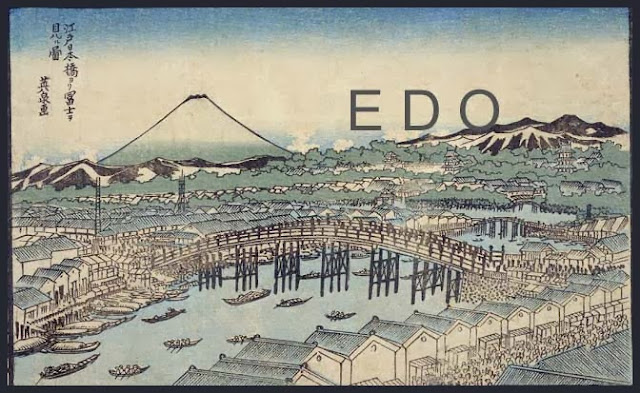
The bridge 両国橋 Ryogokubashi across the 隅田川 Sumida river was constructed on request of Hoshina and Matsudaira to provide an escape road for the townspeople. The land on the other side soon thrived as a popular amusement district, as did many other of the newly built hirokooji 広小路 Hirokoji, Wide Roads, which provided space for yatai 屋台 stalls and evening business.

. Ryoogokubashi 両国橋  Ryogokubashi bridge .


The 天守閣 tenshukaku tower of Edo castle was also lost during the Meireki fire.
It was not rebuilt any more, to express the lasting peace of the Tokugawa bakufu and the money was spent to rebuilt the town. The gates at the other bridges of Edo were also kept open for free transportation and trade in Edo, thus improving the life of the citizens. This also expressed the now lasting peace of the Bakufu, showing that a castle for war defense was no longer needed.

. Edo joo 江戸城 Edojo, Edo Castle .

:::::::::::::::::::::::::::::::::::::::::::::::::::::::::::::::::::::::::::::::::::::::::::::::::::::::::::::::::::::::::::::::::::::::::::::::::::::::::::::::::::::::::::::::::::::

October 9, 1698 - Chokugaku Fire 勅額火事
Also called 元禄江戸大火 or 中堂火事
It started from Kyobashi and by a southern wind spread fast. Soon it came down from Surugadai to Shitaya 下谷、Kanda Myojin Shita 神田明神下 and 湯島天神下 Yushima Tenjin Shita.
Then to 下谷池之端 Shitaya Ikenohata and on to Asakusa. It was stopped by a great rain after 22 hours.
More than 3000 dead.
- - - More in the WIKIPEDIA !

. Shitaya 下谷 and modern Taitō-ku 台東区 Taito Ward .

:::::::::::::::::::::::::::::::::::::::::::::::::::::::::::::::::::::::::::::::::::::::::::::::::::::::::::::::::::::::::::::::::::::::::::::::::::::::::::::::::::::::::::::::::::::

April 22, 1806 - Great Fire of Bunka 文化の大火
文化3年3月4日
Also called 丙寅の大火 or 車町火事 or 牛町火事.
It started in 車町, passed the Kamiyashiki of the Satsuma clan.
It destroyed much of the Ryogoku, Kyobashi and Nihonbashi districts of Edo, and on to Kanda and Asakusa.
Next day came a great rain and the fire extinguished.
More than 1200 dead.

. Kobayashi Issa 小林一茶 and the Shitaya Fire Haiku .
Issa lived in 下谷 Shitaya at that time.

- quote -
Ueno Hirokoji / Shitaya / Yamashita
The area around the present day Ueno Park (the former Kan'ei-ji Temple).
Ueno Hirokoji is the area from the entrance to present day Ueno Park to Matsuzakaya.
After the Great Fire of Meireki (1657), the street width was widened and the area was made into a firebreak. This was a shopping quarter lined with grocery stores, restaurants and other shops along the route of the Onarimichi (a special road used by the imperial family, regents and advisers and the shogun) successive Shoguns throughout history when they went to worship at the Kan'ei-ji Temple.
At the intersection of the present day Chuo St. and Shinobazu St. the Shinobu-gawa River flowed, and there were 3 bridges over it so the area was called Mihashi (three bridges). Matsuzakaya and Mihashi were both pictured in nishiki-e.
Shitaya refers to a section on the east side of Kan'ei-ji Temple (present day Ueno Park), and the name (lower valley) was in reference to Ueno, which was a plateau.
Yamashita (below mountain) refers to being beneath Toeizan. It was located in the area within the present day JR Ueno Station building and the plaza in front of the station. In 1737 it was made into a firebreak after a fire, and became an amusement district with stores and entertainment booths rather than a residential area.
- reference source : ndl.go.jp/landmarks/e/sights -

:::::::::::::::::::::::::::::::::::::::::::::::::::::::::::::::::::::::::::::::::::::::::::::::::::::::::::::::::::::::::::::::::::::::::::::::::::::::::::::::::::::::::::::::::::::

Three Great Fires of Edo 江戸の三大大火

Meireki 明暦の大火
Meguro Gyooninzaka 目黒行人坂の大火 Meguro Gyoninzaka (Meiwa no taika)
Hinoe Tora 丙寅の大火
(Bunka no taika)


- source : gakken.co.jp/kagakusouken -

- quote -
Meguro Gyōnin-zaka slope and Fuji 目黒行人坂冨士
Gyōnin-zaka is a steep slope at Shimo-Meguro, Meguro Ward.
The slope was so named because ascetics from Mt.Yudonosan in Ushū (Yamagata Prefecture)
built a Dainichinyorai-do hall there. ("gyōnin" means "ascetic".)
- source : Tokyo Metropolitan Museum -

:::::::::::::::::::::::::::::::::::::::::::::::::::::::::::::::::::::::::::::::::::::::::::::::::::::::::::::::::::::::::::::::::::::::::::::::::::::::::::::::::::::::::::::::::::::
. Legends and Tales from Japan 伝説 - Introduction .

.......................................................................
Tokyo 文京区 Bunkyo Ward

. The Fire at 伝通院 Temple Denzu-In, Dentsu-In .

.......................................................................
Tokyo 中央区 Chuo Ward

At the Great Bunsei Fire on there was a shop sign that did not burn.
Near the origin of the fire, there was a small hut that did not burn.

.......................................................................
Tokyo 練馬区 Nerima

kitsune 狐 the fox
There lives an old fox in the temple. When he called out, he warned people of a fire, so three or four times a great fire could be averted. He is therefore called

火消稲荷 Fire-extinguishing Inari
a form of hi no kami inari 火の神稲荷, Inari as a Fire Deity.

.......................................................................
Tokyo 西多摩郡 Nishi-Tama district 檜原村 Hinohara village

akai kami 赤い紙 a red paper
A poorly looking traveler was refused to stay over night.
The traveler went to the outskirts of the village, folded a red paper and let it fly.
The paper flew to the home where the traveler had been refused and caused a fire.
Many other homes also burned down that night in a large fire.

.......................................................................
Tokyo 品川区 Shinagawa ward

O-Koojin sama お荒神様 the Venerable Kojin Deity
Once there was a fire in a shopping area in front of Shinagawa station.
A man took a small sancutary of the Kojin Deity, placed it on the roof in the direction of the fire and opened the doors of the sanctuary.
Soon the wind changed direction and the fire stopped at his neighbours house.
. Kojin, Aragami 荒神と伝説 Legends about the Aragami deity .

.......................................................................

- source : nichibun yokai database -

:::::::::::::::::::::::::::::::::::::::::::::::::::::::::::::::::::::::::::::::::::::::::::::::::::::::::::::::::::::::::::::::::::::::::::::::::::::::::::::::::::::::::::::::::::::


- - - To join me on facebook, click the image !

:::::::::::::::::::::::::::::::::::::::::::::::::::::::::::::::::::::::::::::::::::::::::::::::::::::::::::::::::::::::::::::::::::::::::::::::::::::::::::::::::::::::::::::::::::::

. taika 大火と伝説 Legends about big fires in Japan .

. Japanese Architecture - Interior Design - The Japanese Home .

. Famous Places and Powerspots of Edo 江戸の名所 .

. Doing Business in Edo - 商売 - Introduction .

. Legends and Tales from Japan 伝説 - Introduction .


[ . BACK to DARUMA MUSEUM TOP . ]
[ . BACK to WORLDKIGO . TOP . ]- - - - - #edobakufu ##taika #greatfiresinedo #edofires #fire #gyoninzaka - - - -
::::::::::::::::::::::::::::::::::::::::::::::::::::::::::::::::::::::::::::::::::::::::::::::::::::::::::::::::::::::::::::::::::::::::::::::::::::::::::::::::::::::::::::::::::::

10/15/2014

bugyo in Edo

[ . BACK to DARUMA MUSEUM TOP . ]
. Edo bakufu 江戸幕府 The Edo Government and Administration .
::::::::::::::::::::::::::::::::::::::::::::::::::::::::::::::::::::::::::::::::::::::::::::::::::::::::::::::::::::::::::::::::::::::::::::::::::::::::::::::::::::::::::::::::::::: 
bugyoo, bugyō 奉行 Bugyo officials in the Edo government


source : hakuzou.at.webry.info

江戸の名奉行 Famous Bugyo Governor from Edo
丹野顕 - Tanno Akira

..............................................................................................................................................


- quote from wikipedia -
Bugyō (奉行), often translated as "commissioner" or "magistrate" or "governor," was a title assigned to samurai officials of the Tokugawa government in feudal Japan; other terms would be added to the title to describe more specifically a given commissioner's tasks or jurisdiction.

During the Edo period, the numbers of bugyō reached its largest extent. The bureaucracy of the Togukawa shogunate expanded on an ad hoc basis, responding to perceived needs and changing circumstances.
- reference : wikipedia

..............................................................................................................................................

- - - ABC - List (to be updated) - - -

Doochuu bugyoo 道中奉行 - Dochu Bugyo - responsible for controlling the five routes out of Edo (Gokaido), their branch routes and related matters
. Edo Gokaidoo 江戸五街道 Edo Gokaido, Gokaidō - Edo Five Ruotes .

Edo machi-bugyō machibugyoo 江戸町奉行 – Magistrates or municipal administrators of Edo.
. Kita-machi-bugyō (北町奉行) – Kitamachibugyo - North Edo magistrate .
--
-- Minami-machi-bugyō (南町奉行) – South Edo magistrate.
- - - More in the WIKIPEDIA !

. Tooyama 遠山景元 Toyama Saemon no Jo Kagemoto .
(1793 – 1855) Edo Machibugyo


Fukiage-bugyō 吹上奉行 - Supervising the Fukiage park 吹上御苑
..... 吹上花畑奉行, 吹上御花畑奉行

Fushin-bugyō 普請奉行 – Superintendents of Public Works.
- - - More in the WIKIPEDIA !

Gaikoku-bugyō 外国奉行 – Commissioners in charge of trade and diplomatic relations with foreign countries after 1858.
- - - More in the WIKIPEDIA !

Gunkan-bugyō 軍鑑奉行 – Commissioners in charge of naval matters (post-1859).
- - - More in the WIKIPEDIA !


Gusoku-bugyō 具足奉行 – Commissioners in charge of supplying the shogunal armies.
- - Bugu-bugyō 武具奉行 – Commissioners in charge of supplying the shogunal armies (post-1863), replaced Gusoku-bugyō.


Hakodate bugyō 箱館奉行 – Overseers of the port of Hakodate and neighboring territory of Ezo / Hokkaido.
- - - More in the WIKIPEDIA !

. Haneda bugyō 羽田奉行 Haneda Bugyo governor .
commissioners of coastal defenses near Edo (post-1853).

Hata bugyo 旗奉行 - Oversees the flags.

Hyōgo bugyō 兵庫奉行 – Overseers of the port of Hyōgo (post-1864). In the Amagasaki domaine.
- - - More in the WIKIPEDIA !


Jisha-bugyō 寺社奉行 – Ministers or administrators for religious affairs; overseers of the country's temples and shrines.
- - - More in the WIKIPEDIA !

Jiwari-bugyō 地割奉行- Commissioners of surveys and surveying. ...official with responsibility for surveying land ..


Kanagawa bugyō 神奈川奉行 – Overseers of the port of Kanagawa (post-1859).
- - - More in the WIKIPEDIA !

..............................................................................................................................................

Kanjō-bugyō 勘定奉行 – Kanjo Bugyo - Ministers or administrators for Shogunal finance (post-1787).
- - - More in the WIKIPEDIA !

-- Gundai 軍代 – Deputies.
-- Daikan (代官)- Assistant deputies.
. Daikanyama 代官山 - Shibuya .

-- Kane-bugyō 金奉行 – Superintendents of the Treasury.
- - - More in the WIKIPEDIA !

-- Kura-bugyō 倉庫奉行 – Superintendents of Cereal Stores.
- - - More in the WIKIPEDIA !

-- Kinza 金座 – Gold za or monopoly office (post-1595).
- - - More in the WIKIPEDIA !

-- . Ginza 銀座 . Silver za or monopoly office (post-1598).
- - - More in the WIKIPEDIA !

-- Dōza 銅座 – Copper za or monopoly office (post-1636)[14] and (1701–1712, 1738–1746, 1766–1768).
- - - More in the WIKIPEDIA !

-- Shuza 朱座 – Cinnabar za or monopoly office (post-1609).
- - - More in the WIKIPEDIA !

..............................................................................................................................................


Kanjō-ginmiyaku  勘定吟味役 – Supervisor of Financial affairs.

Kantō gundai  関東郡代 – Kantō deputies.

Kinzan-bugyō 金山奉行 – Commissioners of mines.

Koshimono no bugyoo 腰物奉行 - Superintendant of the Government swords and armour
..... 御腰物奉行, 御腰物頭. 御腰物番頭

..............................................................................................................................................


Kyoto shoshidai 京都所司代 -- Shogunal deputies in Kyoto.
- - - More in the WIKIPEDIA !

-- Kyoto machi-bugyō 京都町奉行 – Magistrates or municipal administrators of Kyoto.
- - - More in the WIKIPEDIA !

-- Fushimi bugyō 伏見奉行 – Magistrates or municipal administrators of Fushimi (post-1620).
- - - More in the WIKIPEDIA !

-- Nara bugyō 奈良奉行 – Governors of Nara.
- - - More in the WIKIPEDIA !

..............................................................................................................................................


Machi-bugyō, machibugyoo 町奉行 – Magistrates or municipal administrators in shogunal cities: Edo, Kyoto, Nagasaki, Nara, Nikkō, and Osaka.
- - - More in the WIKIPEDIA !

Nagasaki bugyō 長崎奉行 – Governor of Nagasaki. He enjoyed a lot of freedom with the foreigners.
- - - More in the WIKIPEDIA !

Niigata bugyō 新潟奉行 – Overseers of the port of Niigata.
- - - More in the WIKIPEDIA !

Nikkō bugyō 日光奉行 – Overseers of Nikkō.
Nikkō houses the mausoleum of shogun Tokugawa Ieyasu (Nikkō Tōshō-gū)
- - - More in the WIKIPEDIA !


Ongoku bugyoo 遠国奉行 - magistrates placed at important areas directly controlled by the government

..............................................................................................................................................

Osaka jōdai 大阪城代 – Overseers of Osaka Castle.
- - - More in the WIKIPEDIA !

-- Osaka machi-bugyō (大阪町奉行) – Magistrates or municipal administrators in shogunal cities.
- - - More in the WIKIPEDIA !

-- Sakai bugyō 堺奉行 – Overseers of the town of Sakai, a significant trade center
- - - More in the WIKIPEDIA !

..............................................................................................................................................


Rōya-bugyō 牢屋奉行 – Roya Bugyo Commissioners of the shogunal prison.
His official residence was immediately adjoining the same prison, in Kodenma-chō, Kodenmacho.
- - - More in the WIKIPEDIA !
. Kodenmachō 小伝馬町 Kodenmacho district .


. Sado Bugyo 佐渡奉行 Governor of Sado Island . - Niigata

Sakuji-bugyō 作事奉行 – Commissioners of works, architecture and construction matters (post-1632).
- - - More in the WIKIPEDIA !

Shimoda bugyō 下田奉行 – Overseers of the port of Shimoda and foreign trade in the area..
- - - More in the WIKIPEDIA !

Shomotsu bugyoo 書物奉行 - "Writing Magistrate - Since 1633
..... Go Shomotsu Bugyoo 御書物奉行
..... Momijiyama Bunko


Sunpu jōdai 駿府城代 – Overseers of Sunpu Castle (Shizuoka Castle).
- - - More in the WIKIPEDIA !


Uraga bugyō 浦賀奉行 – Overseers of the port of Uraga.
a port of inspection for Japanese coastal vessels
- - - More in the WIKIPEDIA !

Yamada bugyō 山田奉行 - Representatives of the shogunate at Ise Yamada 伊勢.
to supervise pilgrims and shrines in the area of the Grand Ise Shrine
The town of Ujiyamada 宇治山田,
- - - More in the WIKIPEDIA !

Yari bugyoo 槍奉行 - magistrate of spears

. Yoseba bugyoo 寄場奉行 Yoseba Magistrate .
ninsoku yoseba 人足寄場 rehabilitation facility for criminals / Ishikawajima 石川島 Ishikawa Island in 1790.
Hasegawa Heizô 長谷川平蔵 Hasegawwa Heizo

to be updated
:::::::::::::::::::::::::::::::::::::::::::::::::::::::::::::::::::::::::::::::::::::::::::::::::::::::::::::::::::::::::::::::::::::::::::::::::::::::::::::::::::::::::::::::::::::

- quote -
Law Enforcement in the Edo Period
A COMPLICATED PATCHWORK
The system for maintaining law and order during the Edo period differed fundamentally from our modern system in that law enforcement and criminal justice were carried out by the same organs. That is to say, one agency or office carried out the functions that are today performed separately by police, prosecutors, and the courts. This means that the administrative and judicial functions of government were merged rather than deliberately separated as they are in modern democratic states.
- snip -
A PREMODERN POLICE COMMISSIONER
The third commissioner was the machi bugyô, literally “town commissioner,” sometimes translated as magistrate. The machi bugyô was the top law enforcement official of the most important shogunal domain of all, the city of Edo. If one were forced to choose a corresponding contemporary post, it would have to be that of police commissioner, but it would be more accurate to call the machi bugyô a combination of metropolitan governor, police commissioner, and district court chief justice, since his duties included the adjudication of civil and criminal cases and general administration, as well as administration of the city’s police functions. For this reason, separate police organs were established from time to time to supplement the functions of the machi bugyô. One of these was a special police force called the hitsuke tôzoku aratamekata, which was set up to crack down on vicious gangs of armed robbers; its chief was also selected from among the hatamoto.

Among the men who at one time or another served as magistrate or as chief of the hitsuke tôzoku aratamekata, the most famous evolved into legendary heroes glorified in Japanese novels, movies, and television series—a phenomenon recalling the depiction of Marshall Wyatt Earp in American novels, movies, and TV shows about the wild West.

In Edo there were at any given time two appointed magistrates referred to as the minami (south) and kita (north) bugyô. However, these names are misleading, giving rise to the misconception that each was in charge of half of the city. In fact, the two alternated on active duty, rotating each month; the south and north merely refer to the location of the two magistrates’ offices.

Working beneath the magistrates were supervisors called yoriki and lesser officers known as dôshin. Each magistrate’s office generally had 25 yoriki and somewhere around 120 dôshin (the exact number fluctuated over time). Thus, with the staff for the north and south combined, the entire Edo police force amounted to a mere 50 yoriki and 240 dôshin for a population estimated to have been at least 1 million from the eighteenth century on. To be sure, the magistrate’s office also employed low-ranking officials called chûgen and komono, but these merely provided supporting clerical and other services; only the yoriki and dôshin had police authority. Moreover, as noted above, the magistrate’s office handled not only the investigation and adjudication of criminal cases but also civil suits and general administration. Under the circumstances, how was such a small force able to maintain law and order in such a large city? In the following section, we will examine two important factors.

One factor that allowed the machi bugyô to get by with such a meager staff was the use of unofficial assistants. The dôshin, who handled the criminal investigations, all had working under them community informants known as meakashi or okappiki. These were common townsfolk, not samurai, with no official connection to the magistrate’s office. In many cases they were themselves criminals or even yakuza gang leaders. But they were useful resources for the dôshin because their familiarity with Edo’s underworld often put them in a position to provide information critical to a crime investigation.

Most of these undercover informants ran a business of some type as a means of supporting themselves and, in some cases, their henchmen; many owned restaurants or neighborhood vaudeville theaters. For their services, the dôshin paid them a small amount out of their own pockets. Of course, the use of underworld characters in criminal investigations was problematical in many ways, and the shogunate frequently issued edicts prohibiting the practice, but it seems the dôshin were unable to do without them.

The second factor facilitating the maintenance of law and order in Edo was the important role of community self-government associations. Each neighborhood (called machi or chô) in Edo had an organization made up of the area’s property owners and their managers or superintendents, and headed by someone referred to as the nanushi. The superintendents, known as ienushi or ôya, were in frequent contact with the tenants, who regarded them as powerful authority figures—a relationship frequently portrayed in the comic rakugo monologues of the period.

Working out of an office called the jishinban, the ienushi was charged with settling all kinds of disputes in the neighborhood, at least on a temporary basis, and otherwise keeping order within the community. This sort of self-governing capability no doubt contributed significantly to the maintenance of law and order in Edo. Of course, the communities were only autonomous within the limits set by the shogunate, and the system could be criticized for fostering an atmosphere of suspicion in which people’s activities were continually monitored by their neighbors. However, it also seems clear that it helped keep the peace in Edo by supporting the work of the city’s very modest police force.

We might also note that when the dôshin went on patrol, the jishinban was one of the regular stops along their route. The jishinban was also where suspects were temporarily taken into custody and questioned. All of this suggests that the jishinban was in fact the forerunner of the kôban (police boxes) for which the modern Japanese police system is known.

- - - - - read the full article here :
- source : japanecho.com/sum/2004 - YOSHINO Jun -

:::::::::::::::::::::::::::::::::::::::::::::::::::::::::::::::::::::::::::::::::::::::::::::::::::::::::::::::::::::::::::::::::::::::::::::::::::::::::::::::::::::::::::::::::::::

. sankin kootai 参勤交代 Sankin Kotai Daimyo attendance in Edo
daimyoo gyooretsu, daimyō gyōretsu 大名行列 Daimyo procession .


:::::::::::::::::::::::::::::::::::::::::::::::::::::::::::::::::::::::::::::::::::::::::::::::::::::::::::::::::::::::::::::::::::::::::::::::::::::::::::::::::::::::::::::::::::::


- - - To join me on facebook, click the image !

:::::::::::::::::::::::::::::::::::::::::::::::::::::::::::::::::::::::::::::::::::::::::::::::::::::::::::::::::::::::::::::::::::::::::::::::::::::::::::::::::::::::::::::::::::::

. Japanese Architecture - cultural keywords used in haiku .

. - Doing Business in Edo - 商売 - Introduction .

. senryu, senryū 川柳 Senryu poems in Edo .


[ . BACK to DARUMA MUSEUM TOP . ]
[ . BACK to WORLDKIGO . TOP . ]
- #bugyo #edomachibugyo #edobakufu -
::::::::::::::::::::::::::::::::::::::::::::::::::::::::::::::::::::::::::::::::::::::::::::::::::::::::::::::::::::::::::::::::::::::::::::::::::::::::::::::::::::::::::::::::::::: 

12/27/2015

Sumitomo family business

[ . BACK to DARUMA MUSEUM TOP . ]
. Doing Business in Edo - 商売 - Introduction .
::::::::::::::::::::::::::::::::::::::::::::::::::::::::::::::::::::::::::::::::::::::::::::::::::::::::::::::::::::::::::::::::::::::::::::::::::::::::::::::::::::::::::::::::::::: 

The Sumitomo family 住友家
and doozan 銅山 Dozan copper mines in Japan


- quote
The Sumitomo Group, of which Sumitomo Corporation is a key member, dates to the 17th century establishment of a book and medicine shop in Kyoto by 小次郎政友 Masatomo Sumitomo. Sumitomo's brother-in-law 蘇我理右衛門 Riemon Soga developed a technology to extract silver from copper, and Soga's son (who married Sumitomo's daughter) 住友友以 Tomomochi Sumitomo expanded this smelting business to Osaka.
From this start, the Sumitomo family expanded its business into copper mining (the Besshi copper mine), followed by textiles, sugar and medicine trading.
Its 家号 Yago house name was 泉屋 Izumiya.

The Sumitomo family was close to the Tokugawa shogunate throughout the Edo period. During the 1860s, this relationship became a liability for the firm as the Tokugawa clan warred with rivals in western Japan. Following the Tokugawas' defeat, Sumitomo was almost ruined and under pressure to sell the Besshi mine, which by that point was nearly unworkable. However, Sumitomo kept the mine and improved its output through adoption of new Western techniques.
During the rapid westernization of Japan in ensuing decades, Sumitomo started various new trading, manufacturing and financing businesses, becoming one of the major zaibatsu of early 20th century Japan.

Sumitomo Corporation (住友商事株式会社 Sumitomo Shōji Kabushiki-gaisha)
is one of the largest worldwide Sogo shosha general trading companies, and is a diversified corporation. The company was incorporated in 1919, it is a member company of the Sumitomo Group.
- source : wikipedia


Sumitomo Corporation
- source : sumitomocorp.co.jp -

:::::::::::::::::::::::::::::::::::::::::::::::::::::::::::::::::::::::::::::::::::::::::::::::::::::::::::::::::::::::::::::::::::::::::::::::::::::::::::::::::::::::::::::::::::::

- quote -
住友家の起源 - 始祖・家祖・業祖
住友の姓は、戦国の末、もともと先祖に順美平内友定という人物がおり、桓武天皇の曾孫・高望王の二十二代目にその子・小太郎(忠重)が父の姓と名をとって「住友」の姓を称して室町将軍に仕えて、備中守に任じられたのに始まる。

平家の末裔である戦国武士だった住友家の先祖は、国取り物語の戦国時代を有為転変の歴史を生きる。室町将軍に仕えた「始祖」・住友忠重の子・頼定は、足利義晴に仕え、頼定の子・定信は刑部承と称した。そして、定信の子・定重は、今川義忠(今川義元の祖父)に仕えるが、定重の子・信定の代になり、今川氏が滅んでしまったので、摂津の中川清秀に仕え、入江土佐守と称し、中川十六騎の一人として知られたが、尾崎の陣で戦死してしまう。また入江土佐守(信定)の子・政俊は越前国の柴田氏に仕え、若狭守と称し越前丸岡城にあったが、柴田勝家と共に北庄城で滅んでしまった。政俊の子・長行は、徳川家康の子で結城家へ養子入りした結城秀康に用いられるが、住友家の武家の歴史はここまでである。戦国の習いとはいえ、武家社会の興亡の激しさと無情を感じたのか長行は、自分の子供たちに武家の世界から足を洗わせた。
- - - More in the WIKIPEDIA !

:::::::::::::::::::::::::::::::::::::::::::::::::::::::::::::::::::::::::::::::::::::::::::::::::::::::::::::::::::::::::::::::::::::::::::::::::::::::::::::::::::::::::::::::::::::

- - - - - H A I K U and S E N R Y U - - - - -


新居浜市角野新田町3丁目13番

- quote -
The Besshi copper mine (別子銅山 Besshi dōzan) was a rich source of copper in Niihama, Ehime Prefecture.
The deposits were discovered in 1690, and mining began in the following year. From then until the closing of the mine in 1973, Besshi produced about 700,000 tons of copper, and contributed to Japan's trade and modernization. The Sumitomo family managed the mine, which helped build the Sumitomo zaibatsu. The Dōzan River was named after the copper mine.
The Minetopia Besshi theme park uses some of the mine's facilities.
- source : wikipedia -

During the Edo period, the copper had to be carried from the high mountain down to the beach at Niihama. Male porters with 45 kg in a backpack and female porters with 30 kg had to go down a very small and dangerous mountain path of about 12 kilometers with this load.
In a recent re-creation some male porters made it for just a few meters and than had to give up because it was too dangerous.
Hirose Saihei 広瀬宰平 (1828 - 1914)
was the first 初代住友総理人 Director-General.
- source : Rules Governing the House of Sumitomo -
At the beginning of the Meiji period, modern equipment was introduced by Hirose as much as possible, with mountain railroads and ropeways to carry the burden.
But the immense smoke produced during the melting process caused damage to the local crops 煙害問題.
Iba Teigo 伊庭貞剛 (1847 - 1926) - second director genera.
Even a re-location of the ovens and a huge chimney on an uninhabited island off Niihama 四阪島 could not solve the problem and only caused further damage to a large part of the surrounding farms. Finally special filters were developed to contain the poisonous smoke.
The history of Besshi Copper Mine was taken up in a very instructive TV infotainment in january 2016.


Hyakunen no Kei, Watashi ni Ari
Shirarezaru Meiji SangyouIshin Leader Den
Cast: Enoki Takaaki, Ishiguro Ken,
Asari Yosuke, Asaka Mayumi, Hiki Rie, Yamada Kinuo, Patrick Lample
Synopsis:
Sumitomo’s first director general was Hirose Saihei (Enoki Takaaki) who grew up at the Besshi Copper Mine run by the house of Sumitomo in Shiga Prefecture from young. He convinces Sumitomo to embark on modernising its mine “for the sake of Japan 100 years into the future”.
Persistent and particular about modernisation at the hands of the Japanese, he was an active proponent of transferring Western technology. He made his subordinate Shiono Monnosuke (Asari Yosuke) study in France and learn mining technology. This is how the copper mine was rapidly modernised.
But on the other hand, the smoke emissions from smelting mill caused environmental problems. It was Hirose’s nephew Iba Teigo (Ishiguro Ken) who volunteered to tackle this difficult situation. In order to solve the root of the problem, Iba proposed an incredible plan to move the modern smelting mill, which was completed less than 10 years ago, to another place just like the current. A furious Hirose was absolutely against this reckless plan. But Iba talked him into it and even carried out a huge reforestation plan to restore nature at the mountains of Besshi that had been devastated by mining and smelting that spanned 200 years. Iba would go on to become Sumitomo’s second director general.
How far did the reforms of Hirose and Iba get?
- source : jdramas.wordpress.com -

..............................................................................................................................................


葛がくれ幕府御用の銅の道
kuzugakure bakufu goyoo no doo no michi

hidden in Kuzu
the copper road
of the Bakufu


品川鈴子 Shinagawa Suzuko


別子銅山のぼれば桔梗また桔梗
Besshi doozan noboreba kikyoo mata kikyoo

Besshi copper mine
climbing up there are Chinese bellflowers
and more bellflowers


津村芳水 Tsumura Hosui


. kikyoo 桔梗 Chinese bellflower - Platycodon grandiflorus. .
- kigo for autumn -

.......................................................................

草笛に吹くよ別子の銅山節
kusabue ni fuku yo Besshi no doozanbushi

blowing it
on a reed flute -
the Besshi Copper Mine Song


品川鈴子 Shinagawa Suzuko


別子銅山せっとう節 Besshi Dozan Settobushi
江戸時代から鉱山へ出稼ぎにきた坑夫たちによって歌い継がれた作業歌とされています。
女は絣の着物にタスキがけ、男は坑夫のいでたちで登場します。
- reference -


. kusabue 草笛 "reed flute" .
- kigo for summer -

:::::::::::::::::::::::::::::::::::::::::::::::::::::::::::::::::::::::::::::::::::::::::::::::::::::::::::::::::::::::::::::::::::::::::::::::::::::::::::::::::::::::::::::::::::::

- - - - - There was one more important copper mine in Japan.

Ashio doozan 足尾銅山 Ashio Dozan, Ashio Copper Mine

- quote -
The Ashio Copper Mine, Ashio, Tochigi prefecture, became very significant from the end of the 19th century to the mid-20th century. It was the site of major pollution in the 1880s and the scene of the 1907 miners riots.


The Ashio mine has been in existence at least since 1600 when it belonged to the Tokugawa shogunate. At that time it produced about 1,500 tons annually, although this declined when the mine was closed in 1800. It became privately owned in 1871 following the industrialisation initiated by the Meiji restoration. By 1877 it became the property of Furukawa Ichibei, and by the 1880s production had increased dramatically, reaching 4,090 tons by 1885, 78 per cent of the total output of the Furukawa mines and 39 percent of Japan's copper production.

The Ashio mine was shut down in 1973.
The Ashio Copper Mine Incident is the name given to the environmental disaster that occurred as a result of the Ashio mining operations in the late 19th and early 20th centuries.
- - - More in the WIKIPEDIA !


..............................................................................................................................................

. Kaido 街道 the old highways .

akagane kaido あかがね街道 / 銅街道 copper highway
doozan kaido 銅山街道 copper mine highway

Connecting the Ashio copper mine with the 前島河岸 Maejima coast.
About 45 km long with a difference in hight of about 600 m.


- CLICK for more photos !

..............................................................................................................................................

製錬のにほひかそかに夏山路
seiren no nioi kasoka ni natsu yamaji

the faint smell
of metal smelting
on the summer mountain road


上村占魚 Uemura Sengyo (下野足尾銅山)

.......................................................................


足尾銅山枯葉に重さありにけり
Ashio doozan kareha ni omosa ari ni keri

Ashio copper mine
and the withered leaves
feel so heavy . . .


渡辺恭子 Watanabe Kyoko


:::::::::::::::::::::::::::::::::::::::::::::::::::::::::::::::::::::::::::::::::::::::::::::::::::::::::::::::::::::::::::::::::::::::::::::::::::::::::::::::::::::::::::::::::::::

. Legends and Tales from Japan 伝説 - Introduction .

.......................................................................
Akita 阿仁合村 Aniai - 阿仁銅山 Ani copper mine

gingitsune 銀狐 the silver fox
Once upon a time a rich merchant from Osaka found a silver fox in his garden, but when he woke up from this dream, his wife had turned into a silver fox. So the wife-fox left her husband, but he came after her, travelling around in Japan. One day his wife-fox appeared again and told him, if he climbed up this mountain he would find precious metal.
This is the beginning of the Ani doozan 阿仁銅山 copper mines in Ani .

阿仁鉱山 Ani Kozan mines for copper, gold and silver.
Copper was first found in 1716. Shut down in 1987.


- quote -
Originally developed as a gold mine in 1300s, Ani mine became one of the top three copper mines in Japan with the highest record copper production in 1716 when operated by the Satake clan.
German mining engineers were invited in the 19th century to further improve its production. Ijinkan is a western building that used to accommodate such engineers, including Adolf Meckel, and was later used as a guesthouse after they left. The building was designated a national cultural asset in 1990.
- source : akita-ecotown.com -

. Kaido 街道 Highways of Japan .

Ani Kaidoo 阿仁街道 Ani Kaido Highway

From 角館 Kakunodate via the pass 大覚野峠 Daigakuno Toge to 阿仁銀山町 Ani Ginzan town, then to 米内沢 Yonaizawa and 小繁 Kotsunagi.
The part until the pass is also called
大覚野街道 Daigakuno Kaido
- reference and photos : akitabi.com/ani... -

Connecting to
角館街道 Kakudate Kaido, 刈和野街道 Kariwano Kaido, 生保内街道 Obonai Kaido and 五城目街道 Gojome Kaido.


.......................................................................
Akita 土川 Tsuchikawa - 杉沢銅山 Sugisawa copper mine

katame no sakana 片目の魚 fish with one eye
The stonefish (kajika 鰍) from Tsuchikawa village living below the copper mine lost one eye when the paths were hit by a landslide and the blood of the killed workers flowed down the river, filling one of the fish's eyes.

This mine for gold, silver, copper, lead and zinc in the 大仙市 Daisen town district was closed in 1972.

.......................................................................
Gifu 洞戸村 Horado

hitokui Ebisu 人喰いエビス man-eating Ebisu
This man-eating Ebisu was hit by an arrow from 正之御前 Masa no Gozen at 弓保木, the blood of Ebisu flew down the river at 赤谷 Akadani and he finally fled to 恵比寿山 Mount Ebisusan to the copper mine grotto 銅山岩屋 (also called Ebisugura エベスグラ.)

There is a small shrine in honor of Masa no Gozen 正の御前, 正之御前社.
It is about 540 meter high on Ebisu mountain.


In the shrine is a deity and two bronze mirrors.
A warrior from Echizen who had lost his head in battle and his retainer Masa no Gozen burried it on the mountain.
- source : sankyoharinko -

.......................................................................
- source : nichibun yokai database -

:::::::::::::::::::::::::::::::::::::::::::::::::::::::::::::::::::::::::::::::::::::::::::::::::::::::::::::::::::::::::::::::::::::::::::::::::::::::::::::::::::::::::::::::::::::


- - - To join me on facebook, click the image !

:::::::::::::::::::::::::::::::::::::::::::::::::::::::::::::::::::::::::::::::::::::::::::::::::::::::::::::::::::::::::::::::::::::::::::::::::::::::::::::::::::::::::::::::::::::

. Japanese Architecture - Interior Design - The Japanese Home .

. Famous Places and Powerspots of Edo 江戸の名所 .

. Doing Business in Edo - 商売 - Introduction .

. shokunin 職人 craftsman, craftsmen, artisan, Handwerker .

. senryu, senryū 川柳 Senryu poems in Edo .

. Legends and Tales from Japan 伝説 - Introduction .


[ . BACK to DARUMA MUSEUM TOP . ]
[ . BACK to WORLDKIGO . TOP . ]
- - - - - #sumitomo #besshicopper #edobakufu #akagane #copperkaido - - - -
::::::::::::::::::::::::::::::::::::::::::::::::::::::::::::::::::::::::::::::::::::::::::::::::::::::::::::::::::::::::::::::::::::::::::::::::::::::::::::::::::::::::::::::::::::

8/02/2015

sankin kotai

[ . BACK to DARUMA MUSEUM TOP . ]
. Edo period - History .
::::::::::::::::::::::::::::::::::::::::::::::::::::::::::::::::::::::::::::::::::::::::::::::::::::::::::::::::::::::::::::::::::::::::::::::::::::::::::::::::::::::::::::::::::::: 
sankin kootai 参勤交代 Sankin Kotai Daimyo attendance in Edo
daimyoo gyooretsu, daimyō gyōretsu 大名行列 Daimyo procession


. samurai 侍, buke 武家, bushi 武士   .
Lord of a Domain, Daimyo, daimyoo 大名

. hatamoto 旗本 samurai class .


. shukuba 宿場 post station, postal station .
along the Sankin Kotai roads
Honjin (本陣):
Rest areas and lodgings built for use by samurai and court nobles. Honjin were not businesses; instead, large residences in the post towns were often designated as lodging for government officials.

. Kaido 街道 Highways used by the Daimyo .

..............................................................................................................................................

- quote
Sankin-kōtai 参勤交代 "alternate attendance",
a daimyo's alternate-year residence in Edo - was a policy of the Tokugawa shogunate during most of the Edo period of Japanese history. The purpose was to strengthen central control over the daimyo, or major feudal lords.

History
Toyotomi Hideyoshi had earlier established a similar practice of requiring his feudal lords to keep their wives and heirs at Osaka Castle or the nearby vicinity as hostages for loyal behavior. Following the Battle of Sekigahara and the establishment of the Tokugawa Shogunate, this practice was continued at the new capital of Edo as a matter of custom. It was made compulsory for the tozama daimyo in 1635, and for the fudai daimyo from 1642. Aside from an eight year period under the rule of Tokugawa Yoshimune, the law remained in force until 1862.


Sightseers and merchants gazing at an entourage (sixth panel) from
"Folding Screen Depicting Scenes of the Attendance of Daimyo at Edo Castle",
National Museum of Japanese History

Description
The details changed throughout the 26 decades of Tokugawa rule, but generally, the requirement was that the daimyo of every han move periodically between Edo and his fief, typically spending alternate years in each place. His wife and heir were required to remain in Edo as hostages while he was away. The expenditures necessary to maintain lavish residences in both places, and for the procession to and from Edo, placed financial strains on the daimyo, making them unable to wage war. The frequent travel of the daimyo encouraged road building and the construction of inns and facilities along the routes, generating economic activity.

There were a number of exceptions for certain fudai daimyo in the vicinity of Edo, who were allowed to alternate their attendance in Edo every six months instead. Temporary exceptional dispensations were also occasionally granted due to illness or extreme extenuating circumstances.

In principle, the sankin-kōtai was a military service to the shogun. Each daimyo was required to furnish a number of soldiers (samurai) in accordance with the kokudaka assessment of his domain. These soldiers accompanied the daimyo on the processions to and from Edo.

With hundreds of daimyo entering or leaving Edo each year, processions (大名行列 daimyō-gyōretsu) were almost daily occurrences in the shogunal capital. The main routes to the provinces were the kaidō. Special lodgings, the honjin (本陣), were available to daimyo during their travels.

The sankin-kōtai figures prominently in some Edo period ukiyo-e (woodblock prints), as well as in popular theater such as kabuki and bunraku.
- source : wikipedia

- quote -
Picture of Daimyō Visiting the Castle on New Year's Day
The processions of all the daimyo, or domain lords, were one of the famous sights of the New Year in Edo.
The daimyō leave from their Edo residences to arrive at the castle at about seven in the morning.
The date of this paying of respects was arranged according to the rank of each daimyo
and held not only on New Year's Day but went on over three days.
- source : Tokyo Metropolitan Museum -

under construction
:::::::::::::::::::::::::::::::::::::::::::::::::::::::::::::::::::::::::::::::::::::::::::::::::::::::::::::::::::::::::::::::::::::::::::::::::::::::::::::::::::::::::::::::::::::

NHK samurai drama, August 2015

Ichiroo 一路 Ichiro "One Road"

The adventures of Sankin Kotai, as experienced by 小野寺一路 Onodera Ichiro.

Ichiro’s father dies suddenly in a fire at his home. 19-year-old Ichiro, who had studied in Edo, has to come home. His father was supposed to prepare Sankin kotai and lead the lines of his Daimyo to visit Edo.

After his father's death, Ichiro leads the procession of Sankin kotai and heads to Edo, relying on his father's notes about the proceedings. During the journey, he faces various problems and schemes which target his family.


based on a book by 浅田次郎 Asada Jiro


- reference -

:::::::::::::::::::::::::::::::::::::::::::::::::::::::::::::::::::::::::::::::::::::::::::::::::::::::::::::::::::::::::::::::::::::::::::::::::::::::::::::::::::::::::::::::::::::

- - - - - Legends about Sankin Kotai and Daimyo Gyoretsu - - - - -
There are quite a few tales with the fox or badger. Sometimes they compare their ability in shapeshifting.


............................................................................ Aomori 青森県

The foxes from 三戸 Sannohe
The fox from Akasaka 赤坂の狐 and the fox from Nagane 長根の狐 held a contest in shapeshifting.
The fox from Nagane transformed into a Daimyo procession, which looked quite real with the regional lord and all, when bowing to it from under a tree. The fox of Nagane got caught by the official vassals of the Daimyo and was put to death.


............................................................................ Fukushima 福島県
湖南町 Konan

O-Suga sama お菅さま "Lady Suga"
O-Suga Sama was the wife of the Shogun in Edo. He had been up in Ezo エゾ (Northern Japan and Hokkaido) and since she missed his love so much, she came after him. But she fell sick on the road and eventually committed suicide by drowning in a nearby pond.
She was the youngest of three sisters. When she was a child she liked to roam the forests and look for silkworms. She fed them with leaves and cared for them.

The place is called "O-Suga Sama" and people come here to pray for the well-being of their silk-worms. She observed the silk worms munching leaves with joy and told them:
neesan kuu wa ねえさん食うわ. Since then the leaves were called "kuwa クワ".

When her husband passed the area on his way back, he dreamed that she has become the mist on mount 高井原山 Takaraibarayama to moisten the kuwa leaves.
Her name was actually "O-Sugi お杉", Lady Cedar, but that turned to "O-Suga" in the local dialect.

During the procession of Sankin Kotai there was a great serpent up on a willow tree along the road. It displeased the vassals of the Daimyo and was thus driven away and had to move to Fukushima. When a branch of this willow tree breaks off, there was blood flowing from the wound. So in the end the whole tree was cut off.
This place is called "O-Suga Sama".

. silk 絹 kinu legends .
kuwa 桑 mulberry tree / kuwago 桑子 "kuwa child", "mulberry child", - silkworm


............................................................................ Hiroshima 広島県

. Osangitsune オサンギツネ / 於三狐 O-San kitsune fox with three tails .

Wakamiya no Iwa 若宮の岩 - 大和町 Daiwa

原田備前守が参勤交代で萩原を通ったとき、若宮の岩から白い蛇が現れた。ここを城にしろとのお告げだと思い、城を建てて永住したという。昭和に入ってその岩がトンネル掘削の邪魔になったので、ダイナマイトで壊そうとしたら暴発して作業員が怪我をした。神の住む岩である。

狐,狸 Fox and Badger
昔、於三という悪い狐と、四国の讃岐にいる於三に劣らぬ悪き狸が、どちらが化けるのが上手か比べあった。於三の番がきたとき、於三は今度大名行列に化けるので来てくれといった。約束の日に行くと果たして大名行列が来た。狸が本性を現して近づくと、侍に斬られてしまった。


............................................................................ Hyogo 兵庫県

Shibaemon 芝右衛門 - tanuki and kitsune 狸 - 狐
淡路に芝右衛門という狸がいて、阿波の狸合戦に来て働いたが、その後京都へ上って伏見の狐に遇った。京の狐は口ばかりで腕の程も知れぬから、1つ腕前を見せてくれといわれたので、芝右衛門は翌日大名行列を見せた。盛大な大名行列で、狐は驚きこれは殺してしまわないといけないと思い、次の日におれも大名行列を見せるから稲荷の鳥居に来てくれといった。芝右衛門が約束どおり行くと文句の付けようのない大名行列だったので手を打ち「ヤレヤレ」といってほめたが、それは本物の大名行列で芝右衛門は撃ち殺された。


............................................................................ Kochi 高知県

. The Old Tanuki from 奈半利町 Nahari town .


............................................................................ Nara 奈良県

shirogitsune 白狐 the curse of the white fox
The Lord of Yamato Koriyama 大和郡山 had caught a white fox 白狐 and killed it. The white fox appeared in his dream and asked to have a shrine built so he could go to paradise. But the Lord did not do as he was asked by the spirit. Therefore the white fox cursed him. During his next procession to Edo he behaved quite crazy, like bewitched by the fox. So his family name was taken away and the family line stopped.


. shirogitsune 白狐 Legends about the White Fox .


............................................................................ Niigata 新潟県

Dankuro the Fox and Sankichi the Tanuki 団九郎,三吉 from Sado 佐渡
団九郎狐は、佐渡に住むたちの悪い古狸の三吉を憎んでいた。あるとき信濃川のほとりで団九郎は三吉と出会う。団九郎は三吉をおだてて酒屋の小僧や大入道に化けるなどさせる。団九郎はお礼に自分の芸も見せるといい、次の日に街道に来るようにいう。三吉が約束の場所で待っていると大名行列がやってくる。三吉は感心して行列の前に飛び出るが、それは本物の大名行列で、捕らえられて食べられてしまう。
-
佐渡島には狢が群れをなして住んでおり、その首領の名前を団三郎と言った。鎌倉時代の末期、狐が渡って来て、団三郎と妖術の勝負をした。狐は嫁入りの行列をして見せた。そこで団三郎は大名行列をして見せると狐に行った。狐は大名行列のあまりの見事さに驚いて近寄ったら、その行列は本物で、狐は殺されてしまった。それ以来、佐渡島に狐は来なくなった。

mujina 狢 the Mujina badger from Sado 佐渡
The Mujina badger from Sado and the Fox from 越後 Echigo held a contest in shapeshifting.
The fox shapeshifted into a fire, but was soon found out.
The mujina shapeshifted into a Daimyo Gyoretsu and no one found this strange. So the mujina won.


............................................................................ Yamagata 山形県

遊佐町
onshoo no tama 宝珠の玉
小坊が狐の宝珠の玉を盗んでやろうと、子狐をだました。狐たちが玉を取り返そうと画策するが、のけものにされた狐が計画を小坊に漏らした。大名行列に化けてやってきた狐たちは、本堂に閉じ込められ、小坊の話した犬に噛み付かれて死んだものもいた。


............................................................................ Yamaguchi 山口県

tanuki to kitsune 狸,狐 the badger and the fox

化け上手な阿波狸が、中国地方へ股旅をし、周防の国で狐に化けくらべを申し込んだ。まず阿波狸が、翌々日の午前10時頃に、毛利侯の行列に化けてみせることになった。狸は、その日時に本物の参勤交代の行列が通ることを知っていた。当日、狐は狸が化けたものと信じ込み、狸との約束通り拍手喝采したので、侍に捕らえられて斬り殺されてしまったという。


- source : ukiyoeota/status -

Foxes shapeshift as humans and perform a daimyo gyoretsu.
狐たちが人間を化かして大名行列

- reference : yokai database - nichibun.ac.jp -

:::::::::::::::::::::::::::::::::::::::::::::::::::::::::::::::::::::::::::::::::::::::::::::::::::::::::::::::::::::::::::::::::::::::::::::::::::::::::::::::::::::::::::::::::::::


参勤交代 : 土橋章宏

- reference - books about 参勤交代 -

..............................................................................................................................................


This is probably the definitive work on sankin-kotai in English.

- quote -
What is Sankin-kōtai?
[Sankin-kōtai is] the Alternate Attendance Policy. Established by the Tokugawa Shōgunate, this system required all daimyo to live in Edo for a certain period of time, often every other year.

The daimyō were required to attend (provide service to) the shōgun in Edo and so they set up residences within the city. I like to think of them as embassies from the provinces. The daimyō would bring samurai “staff” from their domains to serve in Edo as well, so these were essentially provincial courts accompanied by a military staff. The daimyō residences included a small palace for the lord and domainal administration as well as barracks for the lower ranking samurai who accompanied the lord.

Each lord generally maintained 3 residences in Edo, though some had more. The land was granted to them by the shōgunate and could be confiscated or redistributed at the discretion of the shōgun or his council of advisors.


. . . . . The trip to Edo and the trip back to the domain were also costly.
The daimyō had to walk, with family and court and staff and in tow, in long processions called 大名行列 daimyō gyōretsu daimyō processions. These elaborate parades took days. But with so many domains coming and going all the time, they were a constant site on the major routes in and out of Edo. There are many great Edo Era prints of these and accounts from foreigners and Japanese alike agreed they were something to see!

- - - - - further info and links :
- source : Marky Star -

- reference - books about sankin kotai -

:::::::::::::::::::::::::::::::::::::::::::::::::::::::::::::::::::::::::::::::::::::::::::::::::::::::::::::::::::::::::::::::::::::::::::::::::::::::::::::::::::::::::::::::::::::

A Daimyo Gyoretsu is just coming over 日本橋 Nihonbashi in Edo,
the first station of the Tokaido road to Kyoto.


CLICK for more photos !

. Utagawa Hiroshige 歌川広重 (1797 - 1861) .

:::::::::::::::::::::::::::::::::::::::::::::::::::::::::::::::::::::::::::::::::::::::::::::::::::::::::::::::::::::::::::::::::::::::::::::::::::::::::::::::::::::::::::::::::::::


- - - To join me on facebook, click the image !

:::::::::::::::::::::::::::::::::::::::::::::::::::::::::::::::::::::::::::::::::::::::::::::::::::::::::::::::::::::::::::::::::::::::::::::::::::::::::::::::::::::::::::::::::::::

. bakufu 江戸幕府 The Edo Government and Administration .

. kido 木戸 The Gates of Edo .

. - Doing Business in Edo - 商売 - Introduction .

. senryu, senryū 川柳 Senryu poems in Edo .


[ . BACK to DARUMA MUSEUM TOP . ]
[ . BACK to WORLDKIGO . TOP . ]
- - - - - #edosankinkotai #sankinkotai #ichiro #onoderaichiro #daimyogyoretsu #edobakufu - - - -
::::::::::::::::::::::::::::::::::::::::::::::::::::::::::::::::::::::::::::::::::::::::::::::::::::::::::::::::::::::::::::::::::::::::::::::::::::::::::::::::::::::::::::::::::::

12/21/2015

Bakufu Edo Government

[ . BACK to DARUMA MUSEUM TOP . ]
. Edo Bakufu - articles .
::::::::::::::::::::::::::::::::::::::::::::::::::::::::::::::::::::::::::::::::::::::::::::::::::::::::::::::::::::::::::::::::::::::::::::::::::::::::::::::::::::::::::::::::::::: 

Edo bakufu 江戸幕府 The Edo Government and Administration
Tokugawa bakufu 徳川幕府 Tokugawa Government


- quote
The Tokugawa shogunate, also known as the
Tokugawa bakufu (徳川幕府) and
the Edo bakufu (江戸幕府), was the last feudal Japanese military government which existed between 1603 and 1867.
The heads of government were the shoguns, and each was a member of the Tokugawa clan. The Tokugawa shogunate ruled from Edo Castle and the years of the shogunate became known as the Edo period. This time is also called the Tokugawa period or pre-modern (Kinsei (近世)).

The bakuhan taisei (幕藩体制) was the feudal political system in the Edo period of Japan. Baku, or "tent," is an abbreviation of bakufu, meaning "military government" — that is, the shogunate. The han were the domains headed by daimyo.

1 History
2 Government
2.1 Shogunate and domains
2.2 Shogun and the Emperor
2.3 Shogun and foreign trade
2.4 Shogun and Christianity

3 Institutions of the shogunate
3.1 Rōjū and wakadoshiyori (roojuu, roju 老中)
3.2 Ōmetsuke and metsuke (oometsuke 大目付)
3.3 San-bugyō (san bugyoo) - three administrators
3.4 Tenryō, gundai and daikan (Tenryo 天領)
3.5 Gaikoku bugyō (gaikoku bugyoo)

4 Late Tokugawa Shogunate (1853–1867)
5 List of the Tokugawa shoguns
- source : wikipedia

karoo 家老 Karo, chief retainer
He stayed at the domain and looked after the regional affairs on behalf of the Daimyo.

under construction
:::::::::::::::::::::::::::::::::::::::::::::::::::::::::::::::::::::::::::::::::::::::::::::::::::::::::::::::::::::::::::::::::::::::::::::::::::::::::::::::::::::::::::::::::::::
- - - - - keywords including BAKU 幕 - - - - -

Bakuchoo Sensoo 幕長戦争 Bakucho Senso war
between the Bakufu and the 長州 Choshu Domain
Chōshū Rebellion
also called 長州征討 Choshu Seito, 長州征伐, 長州出兵, 長州戦争
In the Kinmon Incident on 20 August 1864, troops from Chōshū Domain attempted to take control of Kyoto and the Imperial Palace in order to pursue the objective of Sonnō Jōi. This also led to a punitive expedition by the Tokugawa government, the First Chōshū expedition (長州征討).
第一次長州征討 First Chōshū expedition
- - - More in the WIKIPEDIA !

.......................................................................


幕府放鷹制度 rules about takagari 鷹狩り hawk hunting, falconry (BF)
. takagari 鷹狩 hunting with hawks and falcons .

bakufu kansen 幕府艦船 Bakufu ships (BF)
bakufu kansenn 幕府官船

. bakufu goyootashi 幕府御用達 craftsmen working for the Bakufu government .

.......................................................................

. bakuhan taisei 幕藩体制 Bakuhan system .

.......................................................................

Bakumatsu 幕末 end period of the Bakufu (1853 - 1867)

. Bakumatsu 幕末 写真 photo collection .

. Bakumatsu aera 幕末の人  people visiting Japan (1853 - 1867) .

幕末のジャーナリズムー Bakumatsu Jurnalism
. kawaraban 瓦版 Edo newspaper, handbill, broadside .

.......................................................................


. bakuryoo 幕領 Bakuryo government land, bakufu-owned land, .
bakufu chokkatsu chi 政府直轄地 / bakufu chokkatsu ryoo 幕府直轄領
shogun's direct holdings, personal land- holdings, personal fief of the Tokugawa
tenryoo, tenryō 天領 Tenryo Government Land "Land of Heaven"


. mizubugyoo, mizu bugyō 水奉行 Waterworks administrator .

:::::::::::::::::::::::::::::::::::::::::::::::::::::::::::::::::::::::::::::::::::::::::::::::::::::::::::::::::::::::::::::::::::::::::::::::::::::::::::::::::::::::::::::::::::::

A Shogun (将軍 Shōgun) "general", lit. "military commander"
was a hereditary military dictator in Japan during the period from 1192 to 1867, with some caveats. In this period, the shoguns were the de facto rulers of the country, although nominally they were appointed by the Emperor as a formality. The Shogun held almost absolute power over territories through military means, in contrast to the concept of a colonial governor in Western culture who was appointed by a king.
Sei-i Taishōgun (征夷大将軍, "Commander-in-Chief of the Expeditionary Force Against the Barbarians"
..... in reality shōguns dictated orders to everyone including the reigning Emperor.
Kamakura shogunate (1192–1333)
Ashikaga shogunate (1336–1573)
Tokugawa shogunate (1603–1868)

- - - More in the WIKIPEDIA !

- quote
Shōgun Senge  将軍宣下 appointment to shogun
After donning his ceremonial attire in the Kuro Shoin drawing room,
the Shōgun would be greeted by the Gosanke households
(three households with direct kinship to the Tokugawa household)
and top-ranking Daimyō in the Shiro Shoin before heading to the Ō-hiroma,
where he would read and receive the written decree delivered by the imperial envoy.
Following the ceremony, he would meet with Daimyō and hatamoto.
Through this process, the Shōgun gained authority of the military, government, and legislative system.
The Ō-hiroma was the stage for clear expression of the social hierarchy,
and the Shōgun reigned with supreme authority over the Daimyō
as each of them knelt down before him in turn according to his status.
- source : Tokyo Metropolitan Library

江戸幕府の征夷大将軍‎ The Tokugawa Shoguns

Tokugawa Ieyasu 徳川家康 (1543–1616) - the first Shogun
..... He received the title sei-i taishōgun in 1603
Tokugawa Hidetada 徳川秀忠 (1579–1632)
Tokugawa Iemitsu 徳川家光 (1604–1651)
Tokugawa Ietsuna 徳川家綱 (1641–1680)
Tokugawa Tsunayoshi 徳川綱吉 (1646–1709)

Tokugawa Ienobu 徳川家宣 (1662–1712)
Tokugawa Ietsugu 徳川家継 (1709–1716)
Tokugawa Yoshimune 徳川吉宗 (1684–1751)
Tokugawa Ieshige 徳川家重 (1712–1761)
Tokugawa Ieharu 徳川家治 (1737–1786)

Tokugawa Ienari 徳川家斉 (1793–1853)
Tokugawa Ieyoshi 徳川家慶 (1793-1853)
Tokugawa Iesada 徳川家定 (1824–1858)
Tokugawa Iemochi 徳川家茂 (1846–1866)
Tokugawa Yoshinobu 徳川慶喜 (1837–1913) - the last Shogun

Tokugawa Tsunenari 徳川恆孝 (1940 - ) the 18th generation
His son, Tokugawa Iehiro , is a University of Michigan-educated translator.

- Tokugawa Branch Families
Tokugawa Mitsukuni of the Mito domain
Tokugawa Nariaki of the Mito domain
Tokugawa Mochiharu of the Hitotsubashi branch
Tokugawa Munetake of the Tayasu branch.

- - - - - The Matsudaira clan (松平氏 Matsudaira-shi)
Matsudaira Motoyasu changed his name to Tokugawa Ieyasu
Other branches were formed in the decades after Ieyasu, which bore the Matsudaira surname. Some of those branches were also of daimyo status.
Matsudaira Katamori of the Aizu branch.
Matsudaira Sadanobu, of Shirakawa
- - - - - 4 Key genealogies
4.1 Main line (Tokugawa shogun)
4.2 Hoshina-Matsudaira clan (Aizu)
4.3 Yūki-Matsudaira clan (Echizen) - Fukui Domain and Tsuyama Domain
4.4 Ochi-Matsudaira clan (Hamada)
4.5 Hisamatsu-Matsudaira clan (Kuwana)
4.6 Ogyū-Matsudaira clan (Okutono)
- - - More in the WIKIPEDIA !

:::::::::::::::::::::::::::::::::::::::::::::::::::::::::::::::::::::::::::::::::::::::::::::::::::::::::::::::::::::::::::::::::::::::::::::::::::::::::::::::::::::::::::::::::::::

tairoo, tairō 大老 Tairo "Great Elder" - chief councillor
roughly comparable to the office of prime minister.
- - - More in the WIKIPEDIA !


- quote -
A COMPLICATED PATCHWORK
The system for maintaining law and order during the Edo period differed fundamentally from our modern system in that law enforcement and criminal justice were carried out by the same organs. That is to say, one agency or office carried out the functions that are today performed separately by police, prosecutors, and the courts. This means that the administrative and judicial functions of government were merged rather than deliberately separated as they are in modern democratic states.

Although the Tokugawa shogunate held sway over the daimyô (lords) of all the country’s domains, the administration of each of these domains was left to the individual daimyô; in principle, the shogunate administered only its own domains. However, since the administrative apparatus of each domain, including law enforcement and criminal justice, closely resembled the system established by the shogunate, an examination of the latter system should be sufficient to provide an overview of law enforcement in the Edo period.

The top administrative post under the shôgun was that of rôjû, or senior councillors. (At times a tairô, or chief councillor, was appointed as a superior to the rôjû, but this was not a permanent post.) Typically, the shogunate appointed four or five rôjû from among the fudai daimyô, lords of the domains that Ieyasu, the first Tokugawa shôgun, had originally granted to his loyal vassals in the early seventeenth century. The rôjû generally took turns managing the shogunate’s administrative affairs according to a monthly rotation system, although they came together to confer on matters of importance. Ranking just below the rôjû were the wakadoshiyori, or junior councillors. They were also chosen from among the fudai daimyô and likewise served according to a monthly rotation. Since the rôjû and wakadoshiyori together made up the top administrative organ of the Tokugawa government, they were inevitably involved in matters pertaining to law enforcement and criminal justice, whether directly or indirectly.

Next in importance in the central administrative apparatus were the metsuke (inspectors) and ômetsuke (inspectors general), whose main job was to monitor and control the activities of the ruling warrior class. The ômetsuke, reporting directly to the rôjû, monitored the daimyô, while the metsuke, who were under the supervision of the wakadoshiyori, focused on the shôgun’s direct retainers—the hatamoto, or bannermen, and the gokenin, or housemen. Both were selected from among the hatamoto. With its reliance on peer monitoring, the metsuke system might be compared to the military police of a modern army or the internal affairs bureau of a police department.

The highest offices with direct police and judicial authority were the three bugyô, or commissioners, who reported to the rôjû. While many of the positions within the vast shogunal bureaucracy had originated as military posts in the era of civil unrest prior to the Edo period, the posts of the three bugyô were created after the shogunate was established in Edo, and they had a distinctly civilian flavor.

The first and highest-ranking of the three was the jisha bugyô (commissioner of temples and shrines), who had authority over the lands of all the temples and shrines in the country, the priests and monks attached to those institutions, and the people living within their precincts. In addition to wielding general administrative authority over these lands and people, the jisha bugyô also adjudicated civil suits, investigated crimes, and tried suspected criminals associated with the temples and shrines.

The central job of the kanjô bugyô (commissioner of accounts) was fiscal management, but the holder of this post also wielded police authority with regard to serious crimes carried out within most of the shogunate’s direct holdings. This is because the authority of the gundai or daikan who directly governed those areas (the name depended on the size of the holding) extended only to the collection of taxes from local farmers and the prosecution and adjudication of civil cases and certain minor criminal cases; in all other criminal cases, the accused, together with the record of the preliminary investigation, was sent to the higher court in Edo, namely the kanjô bugyô. Since the kanjô bugyô thus combined the authority of a finance minister and a chief justice, only the most capable people could fill the post, and they were kept very busy. Four people ordinarily filled it on a monthly rotating basis.
- source : japanecho.com/sum/2004 -

:::::::::::::::::::::::::::::::::::::::::::::::::::::::::::::::::::::::::::::::::::::::::::::::::::::::::::::::::::::::::::::::::::::::::::::::::::::::::::::::::::::::::::::::::::::

. nengoo, nengō 年号 Nengo, "year name", era name .


. Edo goyaku 五役(ごやく) the five official workers of Edo .
御駕籠之者(おかごのもの)okagonomono, o-kago no mono
御中間(おちゅうげん)ochuugen, o-chugen
御小人(おこびと)okobito, o-kobito
黒鍬之者(くろくわのもの)kurokuwa no mono
御掃除之者(おそうじのもの)gosooji no mono, go soji no mono

:::::::::::::::::::::::::::::::::::::::::::::::::::::::::::::::::::::::::::::::::::::::::::::::::::::::::::::::::::::::::::::::::::::::::::::::::::::::::::::::::::::::::::::::::::::


rusui, rusui-yaku, rusuiyaku 留守居役 caretaker

- quote -
Rusui yaku were samurai officials in the service of Edo period domains, who oversaw the administration of the domain's mansions in Edo or other cities in the lord's absence. They served an extremely important role as the domain's representative in the city, as administrators and intermediaries, facilitating the domain's involvement in political and economic matters in the major metropolises.
The responsibilities of a rusuiyaku
were diverse and extensive, including maintaining the domain's mansion and preparing it for the arrival and residence of the lord or other members of his household; communicating on behalf of the domain with the shogunate and other official institutions, including at times filing formal inquiries or complaints with the shogunate; and communicating with the rusuiyaku of other domains, as intermediaries in arranging various political, personal, or economic matters between domains; among many other activities.
- source : wiki.samurai-archives.com... -


:::::::::::::::::::::::::::::::::::::::::::::::::::::::::::::::::::::::::::::::::::::::::::::::::::::::::::::::::::::::::::::::::::::::::::::::::::::::::::::::::::::::::::::::::::::

- - - - - Alphabetical Index of Keywords 用語解説 - - - - -

- AAA - / - BBB - / - CCC - / - DDD - / - EEE -

- FFF - / - GGG - / - HHH - / - I I I - / - JJJ -

- KK KK - / - LLL - / - MMM - / - NNN - / - OOO -

- PPP - / - QQQ - / - RRR - / - SSS - / - TTT -

- UUU - / - VVV - / - WWW - / - XXX - / - YYY - / - ZZZ -


:::::::::::::::::::::::::::::::::::::::::::::::::::::::::::::::::::::::::::::::::::::::::::::::::::::::::::::::::::::::::::::::::::::::::::::::::::::::::::::::::::::::::::::::::::::


江戸幕府大事典 Edo Bakufu Daijiten Dictionary
by 大石学 Oishi Manabu

将軍・老中・火付盗賊改・畳奉行・鷹匠、江戸城 ( 門・櫓・堀) ・陣屋・奉行所、参勤交代・幕府の儀式...。
家康から慶喜まで、265年にわたり日本を治めた江戸幕府。最新の成果で描く概論と、職制・陣屋・儀式などの用語解説で、幕府の基礎情報を集成。役職存在期間一覧、索引などの付録も充実した.
年中行事 - 官僚制 - 建築物
役職については、支配・役高・詰間などの基本情報から職務内容・改廃・主要人物なども解説。施設(陣屋・奉行所・役所・牢屋・刑場など)については、現在地・構造のほか、設置から廃止までの沿革も詳述する
(江戸幕府大辞典)

- quote -
- 内容説明
家康から慶喜まで、265年にわたり日本を治めた江戸幕府。最新の研究成果で描く概論と、将軍から牢屋下男にいたる多様な職制や江戸城の諸施設、陣屋、制度・儀式などの用語解説により、幕府の基礎情報を集成する画期的な大事典。役職存在期間一覧・幕府年中行事一覧・江戸城間取り図などの便利な付録・索引も充実した〈江戸幕府〉百科の決定版。

【特色】
●江戸幕府のすべてがわかる
総項目約1800。初期から幕末まで、265年にわたる江戸幕府の政治・制度を理解するための基礎情報を1冊に集成

●江戸幕府をより深く知るための工夫をこらした構成
概説で江戸幕府を総合的に論じ、用語解説で具体的な事項を解説。さらに付録で江戸時代の役職の存在期間や年中行事、幕府施設の所在地などを一覧化する

●最新の研究成果を反映
官僚制・儀式研究・公文書論などの新たな視点も取り入れ、最新の研究成果を反映。施設については、考古学・建築学など周辺分野の成果もふまえて解説する

●江戸幕府の役職・施設を網羅
役職については、支配・役高・詰間などの基本情報から職務内容・改廃・主要人物なども解説。施設(陣屋・奉行所・役所・牢屋・刑場など)については、現在地・構造のほか、設置から廃止までの沿革も詳述する

●江戸城の全貌がよみがえる
城内の各部屋の名称や場所・用途をくわしく解説。そのほか、門・櫓・堀も網羅的に取り上げ、江戸城の全貌を再現する

●充実した巻末付録と、検索が便利な索引を付載
主な付録
*職制図(江戸時代後期と幕末を含む)
*役職存在期間一覧
(江戸時代に刊行された武鑑などから、役職が史料にみえる時期を一覧化)
*幕府年中行事一覧
(御礼惣登城の儀・八朔など幕府の行事から花見・七夕など大奥の行事も一覧)
*江戸・大坂・京都の地図
(町奉行所など、江戸・大坂・京都それぞれの町中の幕府関連施設の位置を図示)
*代官所・遠国奉行所の地図
(全国の陣屋・遠国奉行所の位置を図示)
*江戸城の御殿図
- reference source : yoshikawa-k.co.jp... -


:::::::::::::::::::::::::::::::::::::::::::::::::::::::::::::::::::::::::::::::::::::::::::::::::::::::::::::::::::::::::::::::::::::::::::::::::::::::::::::::::::::::::::::::::::::

. Bakufu Meeting with PowerPoint .

. ninsoku yoseba 人足寄場 rehabilitation prison .
Hasegawa Heizô 長谷川平蔵 and
Law Enforcement in the Edo Period

:::::::::::::::::::::::::::::::::::::::::::::::::::::::::::::::::::::::::::::::::::::::::::::::::::::::::::::::::::::::::::::::::::::::::::::::::::::::::::::::::::::::::::::::::::::

- - - - - H A I K U and S E N R Y U - - - - -

葛がくれ幕府御用の銅の道
kuzugakure bakufu goyoo no doo no michi

hidden in Kuzu
the copper road
of the Bakufu


品川鈴子 Shinagawa Suzuko


. doozan 銅山 Dozan copper mines in Japan .
Besshi copper mine 別子銅山 - Ehime
Ashio copper mine 足尾銅山 - Tochigi

.......................................................................

浜木綿の奔放に裂け幕府跡
hamayuu no honbo ni sake bakufu ato

北見さとる Kitami Satoru

:::::::::::::::::::::::::::::::::::::::::::::::::::::::::::::::::::::::::::::::::::::::::::::::::::::::::::::::::::::::::::::::::::::::::::::::::::::::::::::::::::::::::::::::::::::


- - - To join me on facebook, click the image !

:::::::::::::::::::::::::::::::::::::::::::::::::::::::::::::::::::::::::::::::::::::::::::::::::::::::::::::::::::::::::::::::::::::::::::::::::::::::::::::::::::::::::::::::::::::

. Japanese Architecture - Interior Design - The Japanese Home .

. Famous Places and Powerspots of Edo 江戸の名所 .

. Doing Business in Edo - 商売 - Introduction .


. Legends and Tales from Japan 伝説 - Introduction .

. samurai, warriour, tsuwamono, bushi 侍, 兵、武士、兵士 .


[ . BACK to DARUMA MUSEUM TOP . ]
[ . BACK to WORLDKIGO . TOP . ]
- - - - - #edobakufu #bakufu - - - -
::::::::::::::::::::::::::::::::::::::::::::::::::::::::::::::::::::::::::::::::::::::::::::::::::::::::::::::::::::::::::::::::::::::::::::::::::::::::::::::::::::::::::::::::::::