8/16/2018

Koto ku ward

[ . BACK to DARUMA MUSEUM TOP . ]
. Famous Places and Powerspots of Edo 江戸の名所 .
::::::::::::::::::::::::::::::::::::::::::::::::::::::::::::::::::::::::::::::::::::::::::::::::::::::::::::::::::::::::::::::::::::::::::::::::::::::::::::::::::::::::::::::::::::

Kootoo ku, Kōtō 江東区 Koto ward, "East River"

- quote
Kōtō (江東区 Kōtō-ku), literally "River East", is a special ward located in Tokyo Metropolis, Japan. The ward refers to itself as Kōtō City in English.
... Kōtō is located east of the Tokyo metropolitan center, bounded by the Sumida River to the west and the Arakawa River to the east. Its major districts include Kameido, Kiba, Kiyosumi, Monzen-nakachō, Shirakawa, and Toyosu. The waterfront area of Ariake is in Kōtō, as is part of Odaiba.
... The special ward was founded on March 15, 1947 by the merger of
the wards of 深川区 Fukagawa and 城東区 Jōtō - Joto .
- source : wikipedia


- - - - - There are 45 districts in Koto: - (旧城東区 - T)
- Aomi 青海 -
- Ariake 有明 -
. Botan 牡丹 .
Eitai 永代 . Eitaibashi 永代橋 Eitai-bashi bridge . - Chuo
. Edagawa 枝川 .
. Etchuujima, Etchūjima 越中島 Etchujima district .
. Fukagawa 深川 Fukagawa district .
. Fukuzumi 福住 .
. Furuishiba 古石場 .
. Fuyuki district 冬木 .
. Hirano district 平野 .
. Ishijima 石島 .

. Kameido district 亀戸 .
. Kiba district 木場 "place for wood" - lumberyards and carpenters .
. Kiyosumi district 清住町 / 清澄町 .
. Miyoshi district 三好 .
. Mori district 毛利 .
. Morishita 森下 .
. Monzen-Nakachō 門前仲町 Monzen-Nakacho district .
..... and 古石場川 the river Furuishibagawa
. Ogibashi 扇橋 .
. Ojima 大島 Oshima.

. Saga district 佐賀 .
. Sarue 猿江 "Monkey Inlet" .
. Senda 千田 .
. Sengoku 千石 .
. Shiohama 塩浜 .
. Shiomi 潮見 .
- Shinonome 東雲 -
. Shirakawa district 白河 .
. Shinohashi 新大橋 Shin-Ohashi .
. Shin-Kiba 新木場 .
. Sumiyoshi 住吉 .
. Suna 砂 districts .
- - - Higashisuna 東砂 / Kitasuna 北砂 / Minamisuna 南砂 / Shinsuna 新砂 / Sunamachi 砂町
. Susaki, Suzaki 洲崎 / 須崎 / 州崎 Susaki district .
. Takabashi 高橋 .
- Tatsumi 辰巳 -
. Toyo 東陽 .
. Tokiwa 常盤 .
. Tomioka 富岡 .
. Toyosu 豊洲 fish market .
. Umibe 海辺 .
- Wakasu 若洲 - Wakasu Island - *
. Yumenoshima 夢の島 .


..............................................................................................................................................

Hachimanbashi 八幡橋 - former Danjobashi 弾正橋 「旧弾正橋」「元弾正橋」
A pedestrian bridge over 楓川 the river Kaedegawa to reach the Shrine Tomioka Hachimangu on its West-Bank.
Built in 1878 as the first iron bridge (hagane 鋼 steel).


::::::::::::::::::::::::::::::::::::::::::::::::::::::::::::::::::::::::::::::::::::::::::::::::::::::::::::::::::::::::::::::::::::::::::::::::::::::::::::::::::::::::::::::::::::

. Legends and Tales from Japan 伝説 - Introduction .

................................................................................. Koto 江東区


................................................................................. Fukagawa 深川

. Sanjūsangen-dō 深川三十三間堂 Fukagawa Sanjusan Gendo Hall .
- and Fukagawa Tomioka Hachimangu 富岡八幡宮 Legends


hachi 蜂 bee,kumo 蜘蛛 spider
At the temple 本誓寺 Honsen-Ji the priest has a strange tale to tell.
Once a bee was caught in a spider's net. The spider fought to kill the bee, but the bee got free and flew away.
The spider then took a lotus leaf out of the pond and used its fibers to make a bag. The spider then hid in the bag.
A short time later a huge group of bees came back and stung the bag with the spider many many times. They left after quite some time.
The priest thought the spider must have died, but oh wonder - it crawled out of the bag and was safe !


sakana 魚 fish
In the year 1712 in the middle of the third lunar month, a strange fish was caught. It was all gray like a rat and had hair on its body. The head even looked like a rat. The tail was split into two, like a swallow tail. It also had fins on the body.

.......................................................................

. amagoi 雨乞い ritual and prayer for rain .
In 1787 during a long dry period, the villagers offered prayers for rain and also made a renga 連歌 linked verse with prayers for rain.
After three days the leader had a dream. The Kami Deity told him the rain would soon come and so it did - with quite a thunderstorm!


................................................................................. Fukagawa Kitagawa 深川北川町

. Hokekyoo 法華経 Hokekyo, Hokkekyo, Lotus Sutra .
It happened in the 10 lunar month in 1810.
A box with the Hokekyo Sutra was found in the sea of Kitagawa village in Fukagawa. The fishermen brought it to the 町奉行所 city magistrate office.
When they checked carefully, they found an inscription dating back to the 12th lunar month of 1757.


................................................................................. Fukagawa Sendai Kaigan 深川仙台海岸

. Kappa densetsu 河童伝説 Legends about the Kappa water goblin .
An old manuscript, Shokoku Kenbun Zue 諸国見聞図会, has the following tale:
On the 8th day of the 5th lunar month in 1781 there was a great moat at the Sendai Kaigan shore.
Some children were found dead when they had played in the water during hot summer days. So the villagers drained the moat.
They found a very strange creature. It was fast as lightning and bite someone to death like a dog.
It was a dangerous Kappa !!


................................................................................. Eitaijima 永代島

. ryuutoo 龍燈 / 龍灯 / 竜灯 と伝説 Legends about Ryuto, "Dragon Lantern" .

In the year 1609 there was a spiritual message from 弘法大師 Kobo Daishi.
The most important priests from Mount Koyasan had to come to Eitaibashi to 法談 give lectures about the sutras.
On another occasion, at the 御影堂 Mieido for Kobo Daishi there was a secret lecture about 真言三密 The Three secrets of the Shingon sect.
Each time just before such a meeting, a "Dragon Lantern" was seen.

. Kōbō Daishi Kūkai 弘法大師 空海 - 伝説 
Legends about Kobo Daishi Kukai .
 
- Introduction -


source : 龍燈、龍灯、竜灯- wikipedia


................................................................................. Kameido 亀戸

. Legends from Kameido .

..............................................................................................................................................

- reference : nichibun yokai database -

::::::::::::::::::::::::::::::::::::::::::::::::::::::::::::::::::::::::::::::::::::::::::::::::::::::::::::::::::::::::::::::::::::::::::::::::::::::::::::::::::::::::::::::::::::
- - - - - H A I K U and S E N R Y U - - - - -

街路樹の裾の白粉花江東区
藤田湘子 Fujita Soshi (1926 - 2005)

江東区荒草そよぐのみ驟雨の鞭
橋本夢道 Hashimoto Mudo (1903 - 1974)

江東区は存して秋の雨波紋
古沢太穂 Furusawa Taiho (1913 - 2000)


::::::::::::::::::::::::::::::::::::::::::::::::::::::::::::::::::::::::::::::::::::::::::::::::::::::::::::::::::::::::::::::::::::::::::::::::::::::::::::::::::::::::::::::::::::


- - - To join me on facebook, click the image !

:::::::::::::::::::::::::::::::::::::::::::::::::::::::::::::::::::::::::::::::::::::::::::::::::::::::::::::::::::::::::::::::::::::::::::::::::::::::::::::::::::::::::::::::::::::

. Famous Places and Powerspots of Edo 江戸の名所 .

. Edo bakufu 江戸幕府 The Edo Government .

. Doing Business in Edo - 商売 - Introduction .

. shokunin 職人 craftsman, craftsmen, artisan, Handwerker .

. senryu, senryū 川柳 Senryu poems in Edo .

. Japanese Architecture - The Japanese Home .

. Interior Design - The Japanese Home .

. Legends and Tales from Japan 伝説 - Introduction .


[ . BACK to DARUMA MUSEUM TOP . ]
[ . BACK to WORLDKIGO . TOP . ]
- - - - - #kotoward #kotoku #koto #saga ##koto - - - -
::::::::::::::::::::::::::::::::::::::::::::::::::::::::::::::::::::::::::::::::::::::::::::::::::::::::::::::::::::::::::::::::::::::::::::::::::::::::::::::::::::::::::::::::::::

8/15/2018

Etchujima district Koto

[ . BACK to DARUMA MUSEUM TOP . ]
. Famous Places and Powerspots of Edo 江戸の名所 .
. Persons and People of Edo - Personen .
::::::::::::::::::::::::::::::::::::::::::::::::::::::::::::::::::::::::::::::::::::::::::::::::::::::::::::::::::::::::::::::::::::::::::::::::::::::::::::::::::::::::::::::::::::

Etchuujima, Etchūjima 越中島 Etchujima district, Koto
東京都江東区 越中島一丁目から越中島三丁目 from the first to the third sub-district


The estate of the regent of the former Etchu province,
旗本榊原越中守照清 Hatamoto Sakakibara Etchu no Kami Terukiyo
was located here, hence the name.
Terukiyo was the grandchild of 榊原清政 Sakakibara Kiyomasa (1546 - 1607)

Etchujima was located in the estuary of the river Sumidagawa and was a sand bar, thus named "island".
Eventually the sand bar was lost to rain and storm and Kiyomasa gave the land back to the Edo Bakufu government.
In 1711, after more landfill, the government gave the land to 43 Hatamoto and their retainers and called it
Etchujima cho 越中島町 Etchujima district.
In 1721, other citizens came to live here.
But
In 1730, the official garbage dump of Edo at 永代島 Eitaijima was full and the government decided to make Etchujima the next one, slowly filling the shallow parts of the estuary.

In 1855, the government claimed all the landfills and established the
Koobusho 講武所 Kobusho - Academy for Military Training.
Training places for gun shooting and swimming were added.


. 越中島川 river Etchūjimagawa .

..............................................................................................................................................


東京海洋大学 Tokyo University of Marine Science and Technology
Etchujima Campus - 2-1-6 Etchujima Koto-ku, Tokyo


- HP of the University
- reference source : kaiyodai.ac.jp -


::::::::::::::::::::::::::::::::::::::::::::::::::::::::::::::::::::::::::::::::::::::::::::::::::::::::::::::::::::::::::::::::::::::::::::::::::::::::::::::::::::::::::::::::::::


Etchu no Kuni 越中国 Etchū Province


- quote -
Etchū Province (越中国 Etchū-no-kuni)
was a province of Japan in the area that is today Toyama Prefecture in the Hokuriku region of Japan.
Etchū bordered on Noto and Kaga Provinces to the west, Shinano and Hida Provinces to the south, Echigo Province to the east and the Sea of Japan to the north. Its abbreviated form name was Esshū (越州).
- History
Koshi Province (越国 / 古志国 Koshi no Kuni) was an ancient province of Japan and is listed as one of the original provinces in the Nihon Shoki. The region as a whole was sometimes referred to as Esshū (越州). In 701 AD, per the reforms of the Taihō Code, Koshi was divided into three separate provinces: Echizen, Etchū, and Echigo.
However, in 702 AD,
the four western districts of Etchū Province (Kubiki, Koshi, Uonuma and Kanbara) were transferred to Echigo Province. Etchū annexed Noto Province in 741 AD, but Noto was separated out again in 757 AD. In 746 AD, the noted poet Ōtomo no Yakamochi became Kokushi, and left many references to the region in the poetic anthology Manyōshū.
..... During the Muromachi period, the Hatakeyama clan emerged as shugo regent of the region, but preferred to remain in Kyoto, and to rule through appointed deputies, such as the Jinbō clan and the Shiina clan.
Into the Sengoku period, the Hatakeyama transferred their power base to Nanao Castle in Noto province, and Etchū became an area contested by the Uesugi clan and the Oda clan with the Ikkō-ikki helping play one side against the other. The area was eventually conquered by Oda Nobunaga's general Shibata Katsuie and his deputy Sassa Narimasa, who were later replaced by Maeda Toshiie under the rule of Toyotomi Hideyoshi.
The Maeda clan retained control of the province under Kaga Domain during the Edo period Tokugawa shogunate. During the mid-Edo period, Nei District and much of Niikawa District were separated from Kaga Domain into the 100,000 koku Toyama Domain, which was ruled by a branch of the Maeda clan.
- - - More in the WIKIPEDIA !


source : imagenavi.jp/search...


::::::::::::::::::::::::::::::::::::::::::::::::::::::::::::::::::::::::::::::::::::::::::::::::::::::::::::::::::::::::::::::::::::::::::::::::::::::::::::::::::::::::::::::::::::


source : xxx

越中国 神通川舟橋 / 冨山船橋 Boat Bridge at Toyama

Funahashi 船橋 boat bridge over the river 松川 Matsukawa.
In the Edo period, it was a famous bridge over the river Jinzuugawa 神通川 Jinzugawa, Jinzū River, built only with boats and planks.
In 1998, it was selected as 日本百名橋 one of the 100 famous bridges of Japan.


::::::::::::::::::::::::::::::::::::::::::::::::::::::::::::::::::::::::::::::::::::::::::::::::::::::::::::::::::::::::::::::::::::::::::::::::::::::::::::::::::::::::::::::::::::


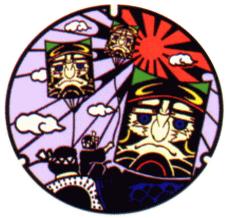
. Etchu Daimon Kite Festival 越中大門凧祭り .


manhole from Daimon Town 大門町

..............................................................................................................................................

越中鵜坂社の尻たたき祭 Etchu Usakasha Shrine - shiri tataki matsuri festival

. shiritataki matsuri 尻たたき祭 "hitting the bottom"
at Iwakura town, Kyoto 


::::::::::::::::::::::::::::::::::::::::::::::::::::::::::::::::::::::::::::::::::::::::::::::::::::::::::::::::::::::::::::::::::::::::::::::::::::::::::::::::::::::::::::::::::::

- - - - - H A I K U and S E N R Y U - - - - -

海の日の越中島の白帆かな
umi no hi no Etchujima no shiraho kana

all the white sails
at Etchujima
on Marine Day . . .

Tr, Gabi Greve

長谷川歌子 Hasegawa Utako

. umi no hi 海の日 Marine Day, Ocean Day .
- - kigo for late summer - -


::::::::::::::::::::::::::::::::::::::::::::::::::::::::::::::::::::::::::::::::::::::::::::::::::::::::::::::::::::::::::::::::::::::::::::::::::::::::::::::::::::::::::::::::::::


- - - To join me on facebook, click the image !

:::::::::::::::::::::::::::::::::::::::::::::::::::::::::::::::::::::::::::::::::::::::::::::::::::::::::::::::::::::::::::::::::::::::::::::::::::::::::::::::::::::::::::::::::::::

. Kōtō 江東区 Koto ward, "East River" .


. Edo bakufu 江戸幕府 The Edo Government .

. Famous Places and Powerspots of Edo 江戸の名所 .

. Doing Business in Edo - 商売 - Introduction .

. shokunin 職人 craftsman, craftsmen, artisan, Handwerker .

. senryu, senryū 川柳 Senryu poems in Edo .

. Japanese Architecture - The Japanese Home .

. Interior Design - The Japanese Home .

. Legends and Tales from Japan 伝説 - Introduction .


[ . BACK to DARUMA MUSEUM TOP . ]
[ . BACK to WORLDKIGO . TOP . ]
- - - - - #etchujima #etchujimakoto - - - -
::::::::::::::::::::::::::::::::::::::::::::::::::::::::::::::::::::::::::::::::::::::::::::::::::::::::::::::::::::::::::::::::::::::::::::::::::::::::::::::::::::::::::::::::::::

8/13/2018

Sumida ward

[ . BACK to DARUMA MUSEUM TOP . ]
. Famous Places and Powerspots of Edo 江戸の名所 .
- for Honjo-Hayashi, see below
::::::::::::::::::::::::::::::::::::::::::::::::::::::::::::::::::::::::::::::::::::::::::::::::::::::::::::::::::::::::::::::::::::::::::::::::::::::::::::::::::::::::::::::::::::
Sumida ku, Sumida-ku 墨田区 Sumida ward, "ink field"


- quote
Sumida (墨田区 Sumida-ku),  is a special ward located in Tokyo Metropolis, Japan. The English translation of its Japanese self-designation is Sumida City.
- - - - - History
The ward was founded on March 15, 1947. It was previously the (ordinary) wards Honjo and Mukojima.
Mukojima, formed in 1932, contained the former town of Sumida, which along with the river gave the ward its name.
- - - - - Landmarks
Tokyo Skytree: A digital terrestrial television broadcasting tower used by NHK and other broadcasters. It is the tallest tower in the world and the tallest man-made structure in Japan.
Ryōgoku Kokugikan (National Sumo Stadium)
Edo-Tokyo Museum
Asahi Breweries Headquarters: The Asahi Beer Hall with the Asahi flame created by French designer Philippe Starck in 1989, is one of Tokyo's most recognizable modern structures.[1]
Eko-in: Buddhist temple
Honjo Matsuzaka-cho Park: the residence of Kira Yoshinaka stood on this site. The Forty-seven Ronin took his life during the Genroku era.
Hokusai-dori (street), with a series of prints by famed Japanese artist Hokusai who was born in the Kamezawa area of Sumida.
Sumida Triphony Hall, concert hall
Tobu Museum
Tokyo Irei-do (Tokyo Memorial Hall): a memorial to those unidentified people who died in the Great Kantō earthquake, the Bombing of Tokyo in World War II and other catastrophes; by Itō Chūta
Yokoamicho Park, in the Yokoami district
- source : wikipedia


. Honjo 本所 and 向島 Mukojima .

- Districts
The river 北十間川 Kitajikkengawa divides: South is former Honjo, North is former Mukojima.
. Jikkendana 十軒店 (じっけんだな) area in Chuo Ward .

北部(旧向島区)Northern Part (former Mukojima)
墨田(すみだ) Sumida
堤通(つつみどおり) Tsutsumidori
東墨田(ひがしすみだ) Higashi-Sumida
八広(やひろ) Yahiro
. 東向島 Higashi-Mukojima . - former Terajima 寺島町/ 寺島村
立花(たちばな) Tachibana
- - - . Shirahige 白ひげ / 白鬚 Shirahige district "white beard" .
文花(ぶんか) Bunka
京島(きょうじま) Kyojima

中央部(旧本所区・向島区)Central part, former Honjo and Mukojima
吾妻橋(あづまばし) Azumabashi
本所(ほんじょ)Honjo
向島(むこうじま) Mukojima
. Narihira 業平 Narihira district .
. Oshiage 押上 Oshiage district . - Sumida
..... Oshinari おしなり Shopping, 東京スカイツリー Tokyo Skytree
..... 押上天祖神社 Oshiage Tenso Shrine / 高木神社 Takagi Shrine / 飛木稲荷神社 Tobiki Inari Shrine
横川(よこかわ)Yokogawa (as opposed to Tatekawa)

南部(旧本所区)Southern part, former Honjo
. Yokoami 横網 Yokoami district .
両国(りょうごく)Ryogoku
千歳(ちとせ) Chitose
石原(いしわら) Ishiwara
亀沢(かめざわ) Kamezawa
. Midori 緑(みどり) "Green" district .
立川 / 竪川 (たてかわ)Tatekawa (as opposed to Yokokawa)
菊川(きくかわ)Kikukawa
太平(たいへい)Taihei
. Kinshi 錦糸 Kinshi "brocade thread" district .
江東橋(こうとうばし)Kotobashi

::::::::::::::::::::::::::::::::::::::::::::::::::::::::::::::::::::::::::::::::::::::::::::::::::::::::::::::::::::::::::::::::::::::::::::::::::::::::::::::::::::::::::::::::::::

. Sumidagawa, Sumida-gawa 隅田川 River Sumida (墨田川, 角田川) .
a river which flows through Tokyo. It branches from the Arakawa River at Iwabuchi and flows into Tokyo Bay.
With many Ukiyo-E by Hokusai.
. Hokusai : 絵本隅田川 両岸一覧 Pictures of Both Banks of the Sumida River .


.......................................................................

. Sumidagawa Shichi Fukujin 隅田川七福神 Seven Gods of God Luck .


::::::::::::::::::::::::::::::::::::::::::::::::::::::::::::::::::::::::::::::::::::::::::::::::::::::::::::::::::::::::::::::::::::::::::::::::::::::::::::::::::::::::::::::::::::


Distant View of the Kinryuzan and the Azumabashi Bridge 吾妻橋金竜山遠望
広重 Utagawa Hiroshige

.......................................................................

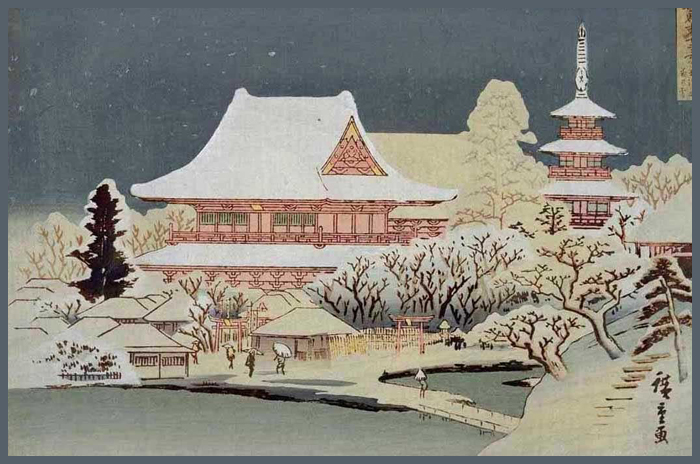
Asakusa Kinryuzan Asa no Yuki 浅草 金竜山 朝の雪
Morning Snow at Asakusa Kinryuzan

Utagawa Hiroshige 歌川広重

.......................................................................

Azuma-bashi / Hiroshige

::::::::::::::::::::::::::::::::::::::::::::::::::::::::::::::::::::::::::::::::::::::::::::::::::::::::::::::::::::::::::::::::::::::::::::::::::::::::::::::::::::::::::::::::::::

- quote -
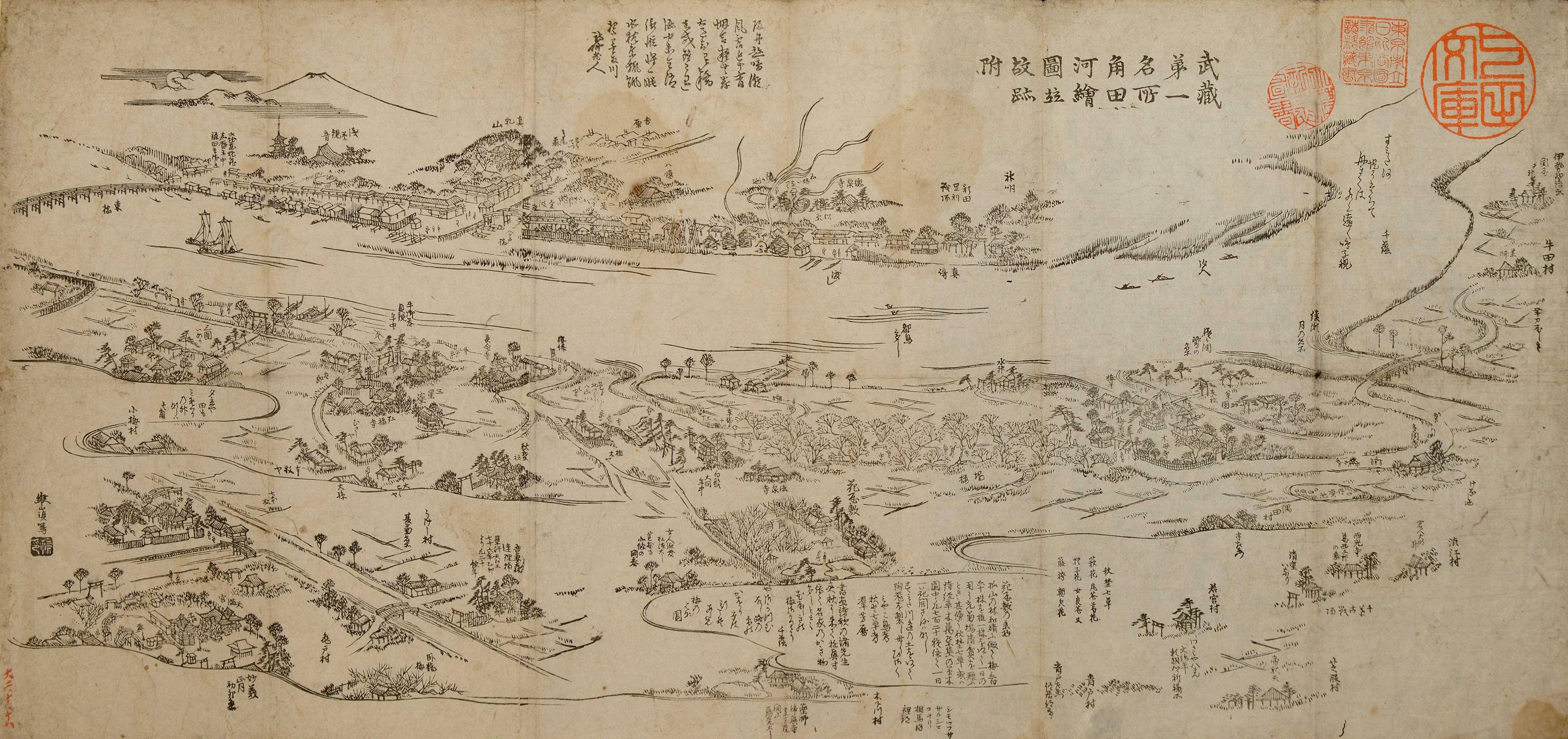
Sumida River and Koseki 武蔵第一名所角田河絵図竝故跡附
This is a picture map indicating the famous places along the Sumida River
between Azuma-bashi bridge and Ushida village.
Not only shrines and temples, but also moon and blossom viewing spots, are introduced.
- source : Tokyo Metropolitan Museum -

- quote -
Sumida River in full bloom
There is a reason why cherry trees were planted along the bank of Sumida River,
which is famous for its sakura (cherry blossoms).
If sakura trees were planted on the bank of a river, people would come and walk along the bank
to see the sakura and the dike would become hardening as a result of treading.
It is said that for this same reason, sakura trees were also planted along Tamagawa aqueduct.
- source : Tokyo Metropolitan Museum -


::::::::::::::::::::::::::::::::::::::::::::::::::::::::::::::::::::::::::::::::::::::::::::::::::::::::::::::::::::::::::::::::::::::::::::::::::::::::::::::::::::::::::::::::::::

. Legends and Tales from Japan 伝説 - Introduction .


................................................................................. Honjo Ishiwara 本所石原町

inu no tatari 犬の祟り the curse of the dog
Around August in 1729, there lived a man in Ishiwara named 徳山五郎兵衛 Tokuyama Gorobei. One of his friends named 八郎 Hachiro suddenly begun to grow a tail like a dog at his behind. Sometimes he did not eat his breakfast for quite a few days. When they put food in a suribachi すり鉢 mortar, he ate it with delight. Then his face begun to change and he became a dog.
This was the curse of all the dogs he had killed in his lifetime.


................................................................................. Honjo Koume 本所小梅町

kitsune 狐 fox
Around 1700, a fox lived in an Inari shrine at Koume. When an old woman from the nearby tea stall called for it, the fox showed up. If other people called for it, the fox never showed up.


本所小梅 Honjo Koume
広重 Hiroshige


本所小梅 Honjo Koume Embankment
広重 Hiroshige


................................................................................. Honjo Matsui 本所松井町

kitsune 狐 fox
In 1822, the colera was rampant.There was also a fox who bewitched people and they lost their ives.
A woman in Matsui town suddenly became crazy and people thought this must have been a fox. She could answer questions and served as a medium. But this became a problem and an exorcist came to help her. She jumped out of a window and they saw a fox running away. The woman did not remember anything.


................................................................................. Honjo Midori 本所緑町

kamikiri 髪切 hair cut off
A maid servant of 善兵衛 Zenbei went to the outhouse, but suddenly became dizzy and fell down. When she came back to her senses and went to the main house, she found that her hair had been cut off.


................................................................................. Honjo Tatekawa 本所竪川通り町

ryootoo no hebi 両頭蛇 serpent with two heads
On the 24th day of the 11th lunar month in 1820, a man named 卯之助 Unosuke walked along the Tatekawa road and saw a snake with two heads. It was about 1 meter long.


................................................................................. Sumida 墨田区

. Mimeguri Jinja 三囲神社 / 三圍神社 Mimeguri Shrine .
an Inari fox deity and the Mitsui Family 三井


.......................................................................
hyakunichizeki 百日咳(百日せき)whooping cough, pertussis
If a child had lived 100 days after being born its mother had to take a different route home, passing over seven bridges. That would protect the child from getting a whooping cough.
If by any bad luck a child got the whooping cough, the mother had to pat the skin of the baby with a 飯杓子 rice paddle and then place the baby into a komebitsu 米びつ container to keep cooked rice for serving. This would heal the baby.

. hyakunichizeki 百日咳/ 百日せき と伝説 Legends about whooping cough .

.......................................................................
sakana 魚 fish
at 安楽寺 temple Anraku-Ji
At the sacred pond of the Temple someone had been fishing with a rod, but then got a high fever and died.
Another person had taken out fish with a net, but he also died soon after.


Tomisaka Inari fox shrine 富坂稲荷
The maid of a certain family once went for an errand as usual but did not come back. When they searched for her, they found her crouching at the Shrine for Tomisaka Inari. She had been bewitched by a fox and even her facial expression had changed. She begun to eat a lot and soon lost her senses.
This also happened to another maid servant and then even to the daughter of the family. Eventually the family was extinguished and the only daughter left had a hard life herself.
She had some exorcist rites done and eventually was healed.

..............................................................................................................................................

- reference : nichibun yokai database -

..............................................................................................................................................

. Shubi no Matsu 首尾の松 "Pine of Success" .
On the bank of the river Sumidagawa

::::::::::::::::::::::::::::::::::::::::::::::::::::::::::::::::::::::::::::::::::::::::::::::::::::::::::::::::::::::::::::::::::::::::::::::::::::::::::::::::::::::::::::::::::::


Honjo Hayashi cho 本所林町 Honjo Hayashi, Honjo-Hayashi
墨田区 Sumida、立川 / 竪川 Tatekawa, first to third district

This area has been developed since 1661, after the Ryogokubashi bridge had been cast over the river Sumidagawa. It was a swamp and many new canals were dug out to get the area dry,
for example 竪川 Tatekawa and 横川 Yokokawa.
On the higher land beside the rivers, new estates of Samurai could now be built. Honjo Hayashi was one of them. It was on the South side of Tatekawa.
The name refers to 旗本 Hatamoto bannerman clan named 林氏 the Hayashi.


. Tatekawa 竪川 (vertical canal) / Yokokawa 横川 (horizontal canal) .
Midorichō 本所緑町 Honjo Midori "Green district"


::::::::::::::::::::::::::::::::::::::::::::::::::::::::::::::::::::::::::::::::::::::::::::::::::::::::::::::::::::::::::::::::::::::::::::::::::::::::::::::::::::::::::::::::::::


- - - To join me on facebook, click the image !

:::::::::::::::::::::::::::::::::::::::::::::::::::::::::::::::::::::::::::::::::::::::::::::::::::::::::::::::::::::::::::::::::::::::::::::::::::::::::::::::::::::::::::::::::::::

. Famous Places and Powerspots of Edo 江戸の名所 .

. Edo bakufu 江戸幕府 The Edo Government .

. Doing Business in Edo - 商売 - Introduction .

. senryu, senryū 川柳 Senryu poems in Edo .

. Japanese Architecture - The Japanese Home .

. Legends and Tales from Japan 伝説 - Introduction .


[ . BACK to DARUMA MUSEUM TOP . ]
[ . BACK to WORLDKIGO . TOP . ]
- - - - - #sumidaku #sumidaward #sumida #sumidagawa #sumidariver - - - -
::::::::::::::::::::::::::::::::::::::::::::::::::::::::::::::::::::::::::::::::::::::::::::::::::::::::::::::::::::::::::::::::::::::::::::::::::::::::::::::::::::::::::::::::::::

8/12/2018

Mita Shikoku Machi district Minato

[ . BACK to DARUMA MUSEUM TOP . ]
. Famous Places and Powerspots of Edo 江戸の名所 .
. Persons and People of Edo - Personen .
::::::::::::::::::::::::::::::::::::::::::::::::::::::::::::::::::::::::::::::::::::::::::::::::::::::::::::::::::::::::::::::::::::::::::::::::::::::::::::::::::::::::::::::::::::

Mita Shikoku Machi 三田四国町 "Shikoku Town" in Mita
港区 Minato 芝2-5丁目 Shiba second to fifth sub-district


The estates of the Daimyo from the four domaines of Shikoku island,
阿波 Awa, 土佐 Tosa, 讃岐 Sanuki and 伊予 Io,
had been here in Mita 二丁目 second sub-district and 三田同朋町 Mita Dobo-Cho.

On the East side of the main road was the Naka-Yashiki of the Daimyo of the Awa Tokushima domain and this part was called Awa Yokocho 阿波横丁 Awa Alley.

Another theory of the name relates to
the estates of the four government officials of 四ヶ国 the four districts
因幡 Inaba, 阿波 Awa, 薩摩 Satsuma and 三河 Mikawa.
or
the estates of the four government officials of 四ヶ国 the four districts
鹿児島 Kagoshima, 徳島 Tokushima, 挙母 Koromo (Aichi) and 因州新田 Inshu Nitta.


In 1872, the area was called 三田四国町, but the name was abolished in 1964.
(In 1947, the area of 三田 Mita had become 芝 Shiba.)

.  Shiba 芝 / 柴村 Shiba mura / 芝町 Shiba machi   .


..............................................................................................................................................

. Darumapedia - 四国 Shikoku - Gallery .

Ehime / Iyo 愛媛 / 伊予
Kagawa / Sanuki 香川 / 讃岐
Kochi / Tosa 高知 / 土佐
Tokushima / Awa 徳島 / 阿波


::::::::::::::::::::::::::::::::::::::::::::::::::::::::::::::::::::::::::::::::::::::::::::::::::::::::::::::::::::::::::::::::::::::::::::::::::::::::::::::::::::::::::::::::::::


. Legends and Tales from Japan 伝説 - Introduction .

In 1890, the family M. (father, son and daughter) had moved to 芝区三田四国町二番町 and lived a pleasant life.
But around the 10th day of the 10th month strange things begun to happen.
The tobacco tray and the hibachi brazier begun to move all by themselves or seemed to be drawn up to the ceiling.
Even in the kitchen things came to life, like the rice container, the mortar, the kettle and the tea cups.
At another occasion, when the family had gone to bed, there were grains of rice and ash falling from the ceiling. This went on for a few days and the young children became quite afraid. So the father decided to go to the bottom of this and put a sharp knife near his pillow . . . but even this knife begun to fly around in the bedroom.
The spook continued, now even the sound of a flute was heard from below the stairs and the paper sliding doors begun to swing in rhythm with it.
The worried father went to the nearby 高輪警察 police station at Takanawa.
They told him to get an exorcist and with proper rituals the spook calmed down and nothing happened any further.
- reference : deep azabu . blogspot -


::::::::::::::::::::::::::::::::::::::::::::::::::::::::::::::::::::::::::::::::::::::::::::::::::::::::::::::::::::::::::::::::::::::::::::::::::::::::::::::::::::::::::::::::::::


- - - To join me on facebook, click the image !

:::::::::::::::::::::::::::::::::::::::::::::::::::::::::::::::::::::::::::::::::::::::::::::::::::::::::::::::::::::::::::::::::::::::::::::::::::::::::::::::::::::::::::::::::::::

. Minato ku 港区 Minato ward, "Harbour ward" .

. Mita 三田 / 御田 / 美田 "Three Rice Fields" - Minato .


. Edo bakufu 江戸幕府 The Edo Government .

. Famous Places and Powerspots of Edo 江戸の名所 .

. Doing Business in Edo - 商売 - Introduction .

. shokunin 職人 craftsman, craftsmen, artisan, Handwerker .

. senryu, senryū 川柳 Senryu poems in Edo .

. Japanese Architecture - The Japanese Home .

. Interior Design - The Japanese Home .

. Legends and Tales from Japan 伝説 - Introduction .


[ . BACK to DARUMA MUSEUM TOP . ]
[ . BACK to WORLDKIGO . TOP . ]
- - - - - #mitashikoku #shikokumita #shikokuminato - - - -
::::::::::::::::::::::::::::::::::::::::::::::::::::::::::::::::::::::::::::::::::::::::::::::::::::::::::::::::::::::::::::::::::::::::::::::::::::::::::::::::::::::::::::::::::::

8/11/2018

Yanagishima district Meguro

[ . BACK to DARUMA MUSEUM TOP . ]
. Famous Places and Powerspots of Edo 江戸の名所 .
::::::::::::::::::::::::::::::::::::::::::::::::::::::::::::::::::::::::::::::::::::::::::::::::::::::::::::::::::::::::::::::::::::::::::::::::::::::::::::::::::::::::::::::::::::

Yanagishima 柳島 Yanagishima district "Island of Willow Trees"
Meguro ward 墨田区 toward Koto ward 江東区 :
墨田区業平 Narihira - 横川 Yokogawa - 太平 Taihei - 錦糸 Kinshi and Koto-ward 江東区亀戸 Kameido


During the Edo period, many willow trees grew here, hence the name.
There were many shallows in this area of the river Sumidagawa, and the land was only fit for farming on the shallows. Some were quite big, like shima 島 islands.
In 1658, the bridge Ryogokubashi was built over the river Sumidagawa, and now the development of the area prospered. The sand was taken from the river to form dams on the sides of the new farming islands.
In 1713, the area came under the jurisdiction of the Edo Bakufu.

It used to be 葛飾郡柳島村 Katsushika district, Yanagishima village.
There were 柳島5か町 five Yanagishima districts in Edo:
柳島横川町 Yokogawa district, 柳島出村町 Demura district, 柳島裏町 Uramachi district,
柳島境町 Sakai district and 葛飾郡の柳島村 Katsushika, Yanagishima village.

In 1869, Uramachi and Sakai became 柳島町 Yanagishima machi.
In 1872, 太平町 Taihei machi was added to these two.
In 1889 during the new city planing, the part of Yanagishima machi and Yokogawa situated to the West of the river 横十間川 Yokojikkengawa became part of 本所区 Honjo Ku ward.
A new district called 柳島元町 Yanagishima Moto-Cho (original district) and another one called
柳島梅森町 Yanagishima Umemori were founded.
南葛飾郡亀戸村 Katsushika Kameido was situated to the East of the river 横十間川 Yokojikkengawa.

In 1910, the new railway lined from Asakusa and Ueno were opened and Yanagishima developed even more.
In 1915 Kameido cho became 亀戸町大字 Kameido Daiji and in 1930, the names
業平橋 Narihirabashi, 平川橋 Hirakawabashi, 横川橋 Yokokawabashi, 太平町 Taihei machi and 錦糸町 Kinshi machi were introduced.

The bridge Yanagishimabashi 柳島橋

was built over the river 北十間川 Kita-Jikkengawa.

The area soon developed some pleasure quarters for even more activities.
There are boat tours along this river to enjoy the new riverside buildings and go all the way
up to 東京スカイツリー the Tokyo Skytree Tower.


source : pixta.jp/photo...

. Narihira 業平 Narihira district .

. Kinshi 錦糸 Kinshi district .


.......................................................................


The temple hall 妙見堂 Myoken-Do was erected to venerate Myoken Bosatsu
and many people came here to pray.


Yanagishima's Mt. Myouken Hosshou Temple(Yanagishima Myouken-san Hosshou-ji), known as "Yanagishima no Myouken-sama" with a history of more than 500 years, is a temple belonging to Nichiren Buddhism. It was founded by holy priests Hosshou-bou Nissen in 1492.
Famous as the temple of faith for Katsushika Hokusai, the artist left many works depicting Hosshou Temple's Myouken Hall (Myouken-do). In addition, it is said that here good fortune was bestowed upon Hiroshige Utagawa and other famed master painters. ...
Katsushika Hokusai, an Ukiyo-e artist active in the Edo period, experienced hardship as a youth when he was excommunicated by his teacher and for a time went so far as to put down his paintbrush. However, he came to "Yanagishima no Myouken-sama" for 21 days and, upon his return home on the last day, was struck unconscious by a bolt of lightening. Subsequently, he quickly became famous and sold paintings, leaving behind many masterpieces. It was thanks to the divine protection of "Yanagishima no Myouken-sama" that he became known worldwide as a famous painter. It is said that Hokusai calling himself Tokimasa Hokusai is due to his piety toward the Hokushin Myouken Great Bodhisattva, enshrined at Myouken Hall. A stone monument venerating Katsushika Hokusai stands in Hosshou Temple
- reference source : yanagishima-myouken.net... -


. Myooken Bosatsu 妙見菩薩 Myoken Bosatsu .


Yanagishima 柳しま 
歌川広重 Utagawa Hiroshige


::::::::::::::::::::::::::::::::::::::::::::::::::::::::::::::::::::::::::::::::::::::::::::::::::::::::::::::::::::::::::::::::::::::::::::::::::::::::::::::::::::::::::::::::::::


river 横十間川 (よこじっけんがわ) Yokojikkengawa, Yokojukkengawa

Yokojikkengawa Riverside Park is long, extending north-south between the Tozai and Toei Shinjuku subway lines.
This end of the park not far from Toyocho Station is like an oasis for seasonal flowers. During lunch time, the benches are filled with company workers having lunch.


- Look at more photos :
- reference source : photoguide.jp... -

One bridge over the Yokojikkengawa was called
Tenjinbashi 天神橋.


::::::::::::::::::::::::::::::::::::::::::::::::::::::::::::::::::::::::::::::::::::::::::::::::::::::::::::::::::::::::::::::::::::::::::::::::::::::::::::::::::::::::::::::::::::


. Legends and Tales from Japan 伝説 - Introduction .

................................................................................. Yanagishima 柳島

a strange baby
In 1825, on the 17th day of the second lunar month, a strange baby girl was floating on the river 本所柳島十軒川 Yanagishima Jikkengawa in Honjo. It was about 30 cm high, with a lot of black hair on her little body. Her navel was above a part with four legs. She also had four holes in her ears and four arms.

..............................................................................................................................................

- reference : nichibun yokai database -

::::::::::::::::::::::::::::::::::::::::::::::::::::::::::::::::::::::::::::::::::::::::::::::::::::::::::::::::::::::::::::::::::::::::::::::::::::::::::::::::::::::::::::::::::::

- - - - - H A I K U and S E N R Y U - - - - -

. yanagi 柳 willow tree and Haiku .


Ogata Korin (1658 - 1716)


::::::::::::::::::::::::::::::::::::::::::::::::::::::::::::::::::::::::::::::::::::::::::::::::::::::::::::::::::::::::::::::::::::::::::::::::::::::::::::::::::::::::::::::::::::


- - - To join me on facebook, click the image !

:::::::::::::::::::::::::::::::::::::::::::::::::::::::::::::::::::::::::::::::::::::::::::::::::::::::::::::::::::::::::::::::::::::::::::::::::::::::::::::::::::::::::::::::::::::

. Meguro 目黒区 Meguro ward .

. Katsushika ku 葛飾区 Katsushika ward .


. Edo bakufu 江戸幕府 The Edo Government .

. Famous Places and Powerspots of Edo 江戸の名所 .

. Doing Business in Edo - 商売 - Introduction .

. shokunin 職人 craftsman, craftsmen, artisan, Handwerker .

. senryu, senryū 川柳 Senryu poems in Edo .

. Japanese Architecture - The Japanese Home .

. Interior Design - The Japanese Home .

. Legends and Tales from Japan 伝説 - Introduction .


[ . BACK to DARUMA MUSEUM TOP . ]
[ . BACK to WORLDKIGO . TOP . ]
- - - - - #yanagishima #yanagishimameguro - - - -
::::::::::::::::::::::::::::::::::::::::::::::::::::::::::::::::::::::::::::::::::::::::::::::::::::::::::::::::::::::::::::::::::::::::::::::::::::::::::::::::::::::::::::::::::::

8/10/2018

Adachi ward

[ . BACK to DARUMA MUSEUM TOP . ]
. Famous Places and Powerspots of Edo 江戸の名所 .
::::::::::::::::::::::::::::::::::::::::::::::::::::::::::::::::::::::::::::::::::::::::::::::::::::::::::::::::::::::::::::::::::::::::::::::::::::::::::::::::::::::::::::::::::::

Adachi ku 足立区 Adachi ward
located in the North-East of Tokyo, between the river 隅田川 Sumidagawa and 荒川 Arakawa.


The first spelling of ADACHI was 阿太知.
or the name was
ashi dachi 葦立ち(アシダチ)area were reed grass (ashi) stands (tachi).

It used to be named 千住区 Senju ku and became known through the writings of Matsuo Basho about Senju.
The 千住地区 Senju sub-district is now located along the South side of river Arakawa.

In the Edo period it was a postal station for the 日光街道 Nikko Kaido Highway and the 奥州街道 Oshu Kaido Highway.
. Ōshū Kaidō 奥州街道 Oshu Kaido .

In the Muromachi period the regent was 千葉氏 the Chiba clan, who was then overthrown by the
小田原北条氏 Odawara Hojo Clan.

The 武蔵国の足立郡 Adachi district of Musashi no Kuni had 10 villages in South-Adachi in 1878.

There are quite a few sub-districts in Adachi.


千住大橋 / 千住の大はし Senju Ohashi Bridge
Utagawa Hiroshige


- quote
It is located north of the heart of Tokyo. The ward consists of two separate areas: a small strip of land between the Sumida River and Arakawa River and a larger area north of the Arakawa River. The ward is bordered by the cities of Kawaguchi, Sōka and Yashio in Saitama and Katsushika, Sumida, Arakawa, and Kita in Tokyo.
The ward is called Adachi City in English.
- - - - - History
Under the Ritsuryō system, the present-day ward was the southern extremity of Adachi District, Musashi Province.
In 826, during the Heian period, the Nishiarai Daishi temple was founded. During the Muromachi period and into the Sengoku period, the Chiba clan held control of the region. The Great Senju Bridge was built in 1594.
In the Edo period, parts were under the direct control of the Tokugawa shogunate, and parts were under the administration of Kan'ei-ji, a temple in present-day Ueno, Tokyo. Adachi was also home to Senju-shuku was a post station on both the Nikkō Kaidō and the Mito Kaidō. The shogunate maintained the Kozukappara execution grounds in Senju.
In 1932, Adachi, formerly known as Minamiadachi District, became a ward of Tokyo City. The special ward was founded on March 15, 1947.
----- Tokyo Budokan
Tokyo Budokan, located within Higashi Ayase Metropolitan Park, is a sports facility run by Tokyo Sport Benefits Corporation. The Tokyo Budokan has an avant-garde building designed by a famous architect Kijō Rokkaku. It includes places for martial arts and Kyūdō, and training rooms. The word budokan means "martial arts hall," and the same word is part of the name of the more-famous Nippon Budokan.
----- Parks
Toneri Park
Higashi Ayase Park
Urban Agricultural Park
----- List of famous shrines and temples in Japanese wikipedia
----- more
- source : wikipedia


- Adachi City Tokyo Facebook -


..............................................................................................................................................


. Musashi no Kuni 武蔵国 Musashi Province / Bushuu 武州 Bushu .

.- The 27 stations of the Ōshū Kaidō 奥州街道 .

..............................................................................................................................................

Arai 西新井 Nishi-Arai / 西新井本町 Nishiarai Honcho
. Nishiarai Daishi 西新井大師 Nishi-Arai Daishi .

. Ayase 綾瀬 "twilling shallows" district .
Adachi足立区 綾瀬一丁目から七丁目 from the first to the seventh sub-district

. Senju 千住 Senju district .
Senju 千住元町 / 千住三丁目 / 千住仲町 / 千住橋戸町 / 千住桜木 / 千住大川町 / 千住宮元町

. Takenotsuka, Takenozuka 竹の塚 / 竹ノ塚 Takenotsuka district .

. Toneri 舎人(とねり)Toneri district .

Shinden 足立区新田 Adachi Shinden area

Shintoyohashi Bridge 新豊橋

::::::::::::::::::::::::::::::::::::::::::::::::::::::::::::::::::::::::::::::::::::::::::::::::::::::::::::::::::::::::::::::::::::::::::::::::::::::::::::::::::::::::::::::::::::


. Saranuma Fudo 皿沼不動 永昌院 Eisho-In .
東京都足立区皿沼1丁目4-2 / 1 Chome-4-2 Saranuma, Adachi, Tokyo

. 足立百不動 100 Fudo Pilgrim Temples in Adachi .  
- Introduction -


. Matsuo Basho in Senju .
Oku no Hosomichi - the beginning


source : www.yumekougei.com

::::::::::::::::::::::::::::::::::::::::::::::::::::::::::::::::::::::::::::::::::::::::::::::::::::::::::::::::::::::::::::::::::::::::::::::::::::::::::::::::::::::::::::::::::::


. Legends and Tales from Japan 伝説 - Introduction .


................................................................................. Adachi 足立区

hibashira ヒバシラ / 火柱 pillar or flames
A pillar of flames is produced by an itachi イタチ / 鼬 weasel making a fire. When people see the red flames growing high in the air, they know something bad is going to happen.


hitodama ヒトダマ human fireball
It looks like a blue flame for a man and a red flame for a woman. If a person sees it, there will be someone dying in the family within the next two or three days.
If someone has never seen it as a child, he will live a lucky life. If a child sees it, it will not be able to make a good career.


kanedama カネダマ / 金玉 "ball of money"
A Yokai that carries money.
It moves around and flies with a growl. If it comes out of a home, this family will perish.
In another family a Kanedama had fallen into the back yard more than 30 years ago and the family flourished.

- reference : wikipedia - kanedama -

.......................................................................

. kitsune densetsu 狐と伝説 fox legends .
In 1907, a bunke 分家 branch family split from the main family. The Inari deity from the main family followed them and they built a yashiki inari 屋敷神稲荷 small shrine in the compound to venerate it.
Since then they never had a fire, thanks to the Inari.


.......................................................................

yuurei 幽霊 ghost
At 江戸柳原 Yanagihara in Edo a woman had died in 1683 in the summer.
At that time a ghost had appeared in the evening and pulled the sleeve of a maid servant. When she came back from her errant, the whole sleeve had disappeared. Next morning she went to the grave of the dead woman and found the sleeve hanging on 石塔 the grave stone pagoda.


................................................................................. Saitama 埼玉県
. さいたま市 Saitama city .

happyaku bikuni 八百比丘尼 / ハッピャクビクニ a nun of 800 years
武蔵国足立郡水波田村 In the Adachi district, at the temple 慈眼寺 Jigen-Ji,
there was a huge enoki 榎 nettle tree cut down, the open cut covering a huge size of the ground.
This tree had been planted by a Happyaku Bikuni nun from 若狭 Wakasa. When the villagers dug deeper, they found the statue of Jizo Bosatsu in a stone box, with an inscription dating to 大化元年 the year 645. This Bikuni must have lived for more than 1000 years.

..............................................................................................................................................

- reference : nichibun yokai database -

::::::::::::::::::::::::::::::::::::::::::::::::::::::::::::::::::::::::::::::::::::::::::::::::::::::::::::::::::::::::::::::::::::::::::::::::::::::::::::::::::::::::::::::::::::


- - - To join me on facebook, click the image !

:::::::::::::::::::::::::::::::::::::::::::::::::::::::::::::::::::::::::::::::::::::::::::::::::::::::::::::::::::::::::::::::::::::::::::::::::::::::::::::::::::::::::::::::::::::

. Famous Places and Powerspots of Edo 江戸の名所 .


. Edo bakufu 江戸幕府 The Edo Government .

. Doing Business in Edo - 商売 - Introduction .

. shokunin 職人 craftsman, craftsmen, artisan, Handwerker .

. senryu, senryū 川柳 Senryu poems in Edo .

. Japanese Architecture - The Japanese Home .

. Legends and Tales from Japan 伝説 - Introduction .


[ . BACK to DARUMA MUSEUM TOP . ]
[ . BACK to WORLDKIGO . TOP . ]
- - - - - #adachi #adachiward #adachitokyo - - - -
::::::::::::::::::::::::::::::::::::::::::::::::::::::::::::::::::::::::::::::::::::::::::::::::::::::::::::::::::::::::::::::::::::::::::::::::::::::::::::::::::::::::::::::::::::